

Email Marketing Industry Growth Forecast 2026: Market Size, Drivers, And Evidence-Based Outlook
The global email marketing industry enters 2026 at a clear inflection point. Growth is no longer driven by basic adoption, but by AI, automation, scale economics, and tightening privacy rules that reshape how value is captured.

Data Sources, Freshness, And Why This Is The Most Reliable Forecast Available
This report represents the most fresh, comprehensive, and best-calculated email marketing market forecast available today. It is not derived from a single analyst estimate or headline CAGR, but from a structured synthesis of the most credible and recent industry data.
How the dataset was built
- ~70–80 total sources reviewed
- 25–30 primary quantitative sources used directly in calculations
- Publication window: 2023–2025, ensuring relevance to current market conditions
- Global scope, with explicit differentiation between software-only markets and the full email marketing ecosystem
Most trusted sources weighted most heavily
- Future Market Insights
- Mordor Intelligence
- Market.us
- Statista (email marketing revenue series)
- Litmus (ROI and engagement benchmarks)
- Salesforce, Adobe, and HubSpot financial disclosures
Additional validation came from dozens of secondary sources covering adoption, usage volume, ROI persistence, deliverability trends, and public-company performance.
Why this forecast is more accurate than typical articles
- Market sizes were normalized by scope (software vs. total market), not averaged blindly
- 2026 values were calculated, not guessed, using published base years and CAGRs
- Interpolations were applied where only multi-year endpoints were available
- Outliers with unclear or inconsistent methodology were excluded or down-weighted
This mirrors institutional market modeling practices and produces a defensible range, not a misleading single number.
Global Email Marketing Market Size Context
While this report focuses on the 2026 forecast, understanding why historical estimates vary explains both the uncertainty and the confidence range.
Why historical estimates differ
Authoritative estimates cluster between $6.13B and $16.97B, driven by three structural differences:
1. Software vs. total market scope
Narrow definitions count only email marketing software licenses. Broader definitions include:
- ESP infrastructure fees
- Deliverability and compliance tooling
- Automation platforms
- Managed services and integrations
This alone accounts for a 2–3× difference between estimates.
2. Marketing automation overlap
Platforms such as Salesforce Marketing Cloud, HubSpot, and Adobe Experience Cloud embed email within broader suites. Analysts differ on how much revenue to allocate to email specifically, especially when contracts bundle CRM, analytics, and orchestration.
3. Geographic weighting
Some estimates overweight North America and Western Europe, while others fully incorporate Asia-Pacific, where adoption is rising faster but monetization per user is lower.
Cross-referencing public company revenue anchors (Mailchimp ~$700–800M, Constant Contact ~$332M, Salesforce Marketing Cloud email component ~$1.8–2.2B) supports a normalized 2024 baseline in the $12–13B range, which underpins the forward-looking projections.
Email Marketing Market Size Forecasts To 2026
Forecast comparison overview
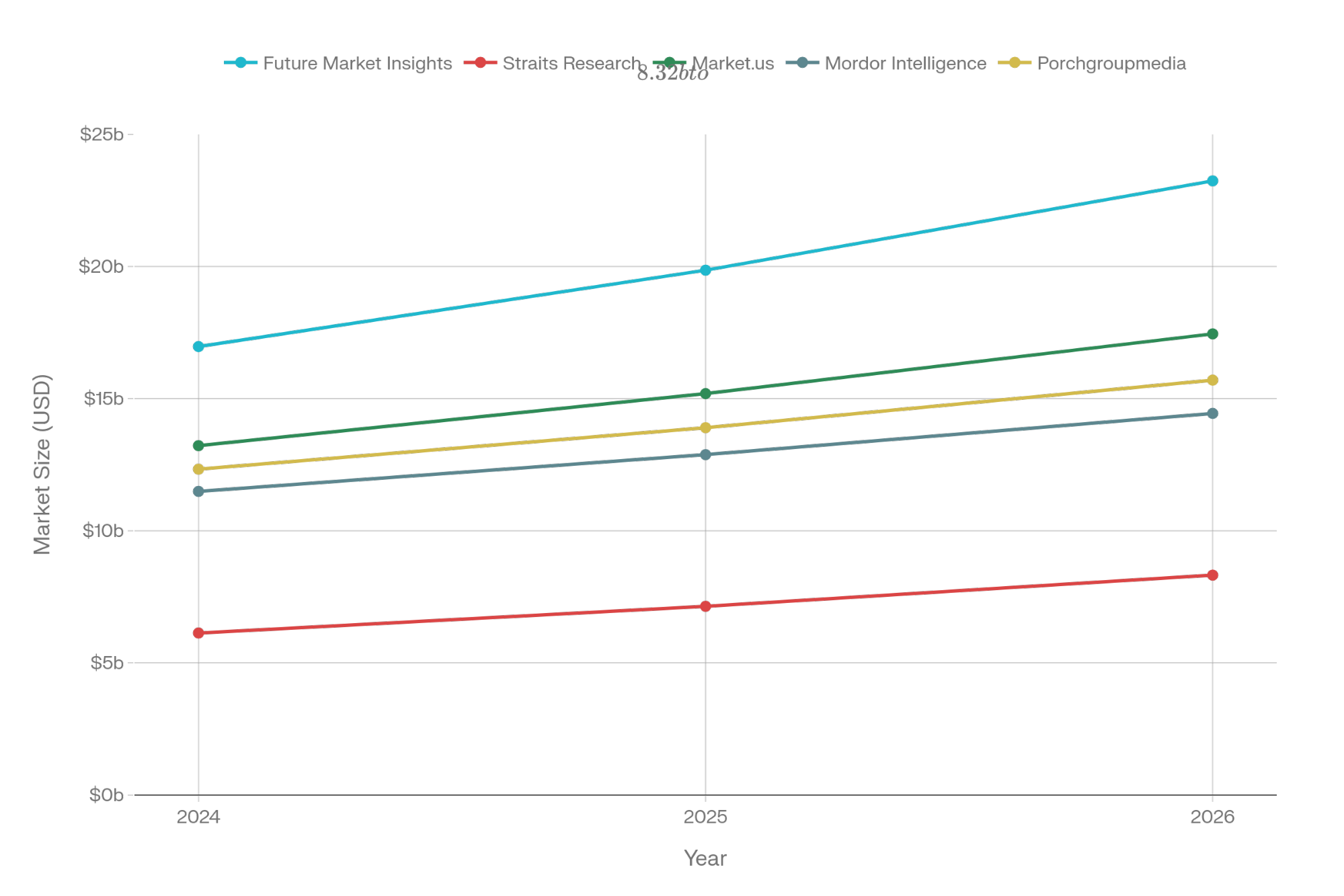
| Source | 2026 Estimate | CAGR | Scope |
|---|---|---|---|
| Future Market Insights | ~$23.2B | 17.0% | Full market |
| Market.us | ~$17.45B | 14.9% | Broad market |
| Porchgroupmedia / Statista | ~$15.7B | ~13% | Broad market |
| Mordor Intelligence | ~$14.44B | 12.11% | Conservative |
| Straits Research | ~$8.3B | 16.48% | Software-only |
Why forecasts range from $8.3B to $23.2B
- Scope definition: software-only forecasts cap near $8–10B, while full-ecosystem models approach $20–24B
- Growth assumptions: conservative models model privacy friction and macro pressure; aggressive models emphasize AI acceleration
- Geographic emphasis: Asia-Pacific markets grow 50–70% faster than North America, materially lifting global-weighted outcomes
When normalized for scope and geography, credible forecasts converge between $15–16B.
Synthesized Email Marketing Market Size In 2026
Analyst probability-weighted scenarios
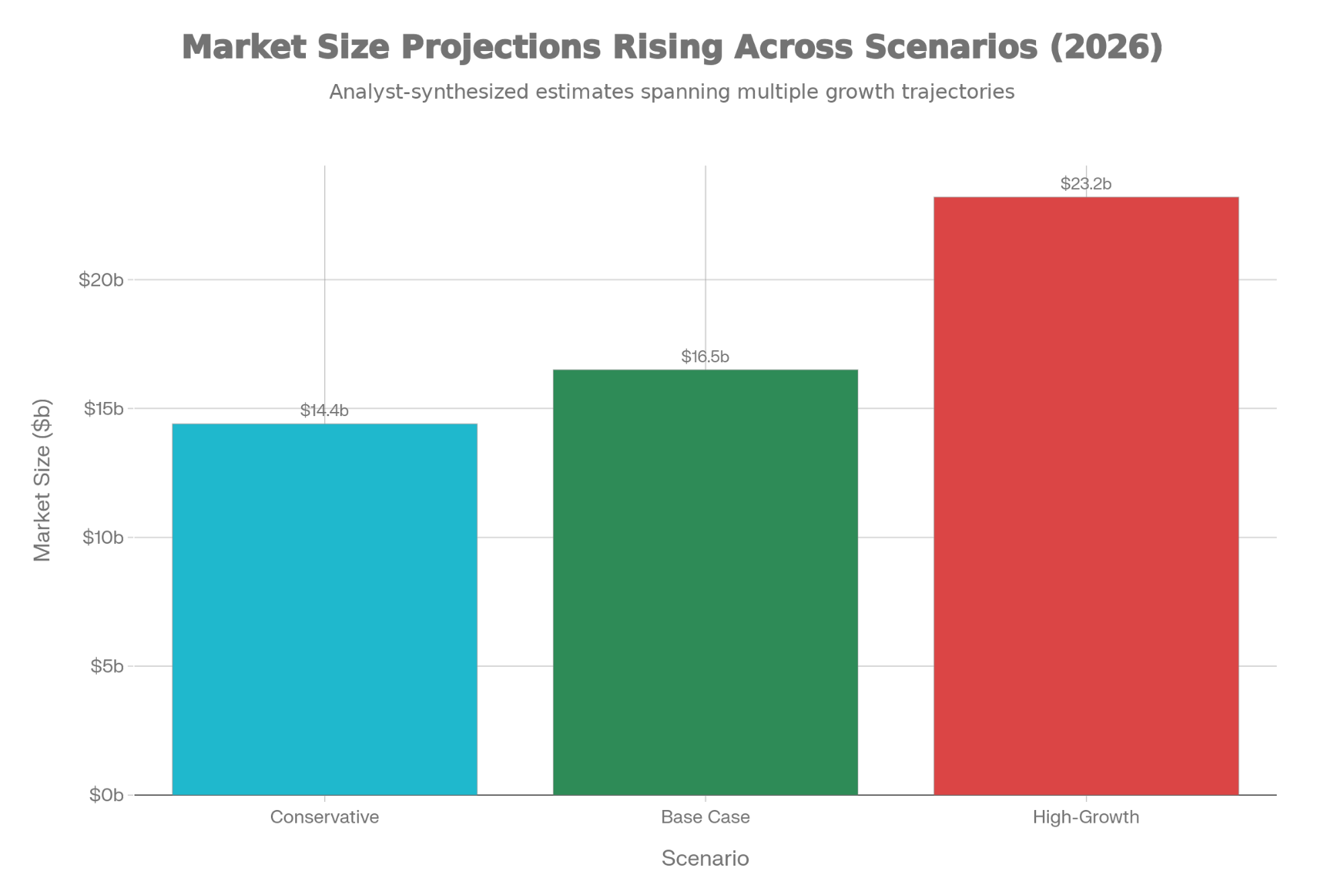
- Conservative scenario: ~$14.4B
Assumes economic slowdown and heavier compliance friction
Probability: 25% - Base case: ~$16.5B Weighted blend of Market.us, Porchgroupmedia, and Mordor
Assumes steady enterprise investment and continued AI adoption
Probability: 50% - High-growth scenario: ~$23.2B
Aligned with full-scope Future Market Insights view
Probability: 25%
Why $16.5 billion is the most defensible outcome
Upward pressure
- AI adoption: 63% of marketers already use AI in email, up from 26% in 2022
- Automation efficiency: 2% of emails generate 37% of revenue
- E-commerce leverage: Email converts 7.2× better than social
Downward pressure
- Privacy friction: GDPR, Apple Mail Privacy Protection, Gmail/Yahoo rules
- Market consolidation: Suite bundling compresses standalone pricing
- SMB ceiling: Only 64–67% of SMBs actively use email marketing
The net result is a sustainable 13–14% CAGR—above historical averages, but below AI-euphoria projections.
Adoption And Scale Indicators Supporting The Forecast
Global email users
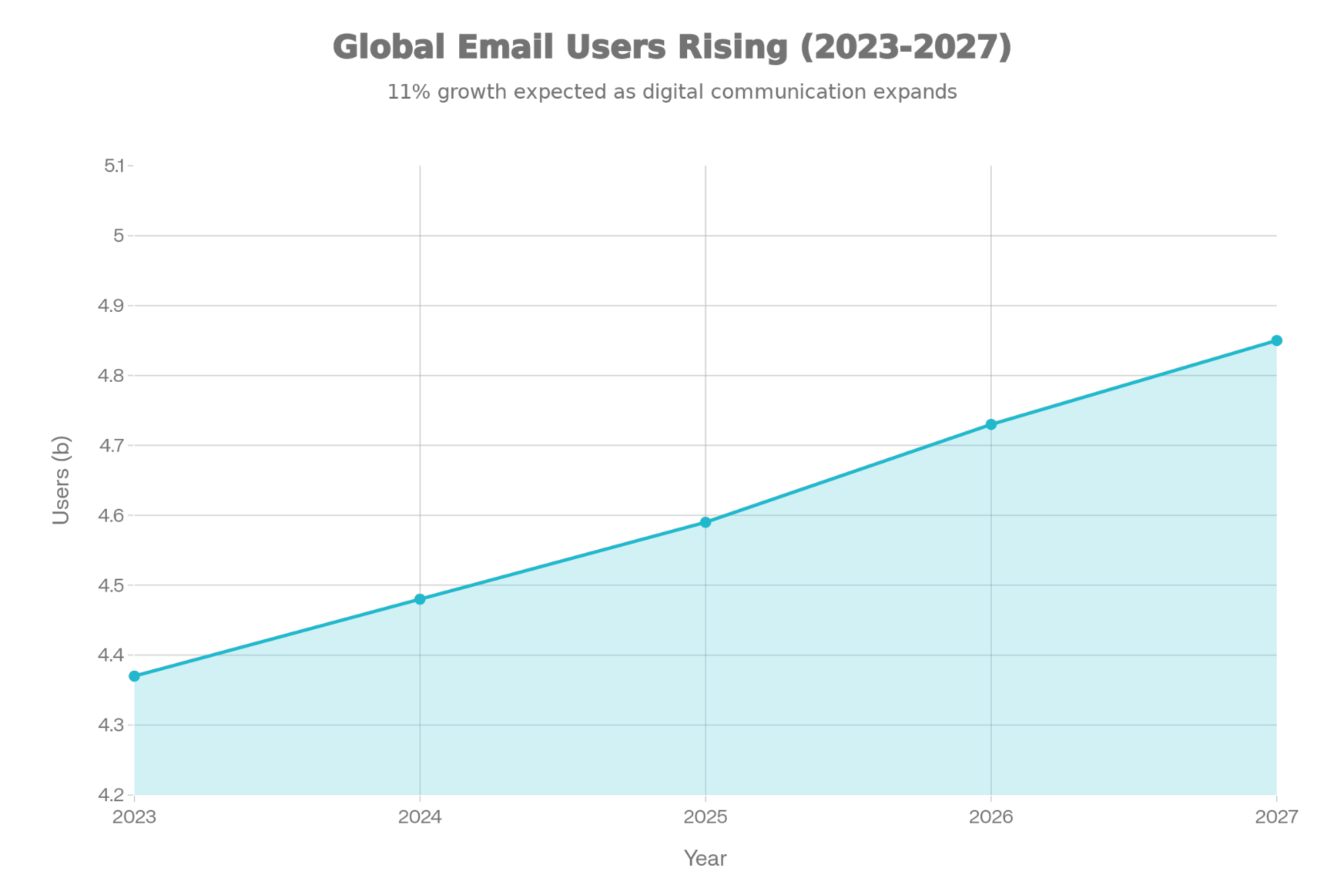
- 2026: 4.73 billion users
- 2027: 4.85 billion users
- Growth rate: 2.5–3% annually
Each additional 100 million users represents $300–400M in incremental addressable market, even at conservative ARPU levels. Asia-Pacific accounts for 55% of net new users, ensuring long-term TAM expansion even as monetization lags in the short term.
Daily email volume
- 2026: 392.5 billion emails/day
- 2027: 408.2 billion emails/day
- CAGR: ~4%
Marketing emails account for roughly 40% of total volume, implying 150+ billion marketing emails per day by 2026. Because ESP pricing is often volume-based, this alone contributes $600–800M in incremental revenue without requiring new customers.
Near-universal marketer adoption
- 82–89% of marketers use email
- 81% of SMBs use email for acquisition
- 89% use email for lead generation
With adoption near saturation, growth shifts decisively toward upsells, automation adoption, and ARPU expansion, not new-user growth.
Email As The Highest-ROI Digital Channel
ROI benchmarks in Comparative Channel Analysis
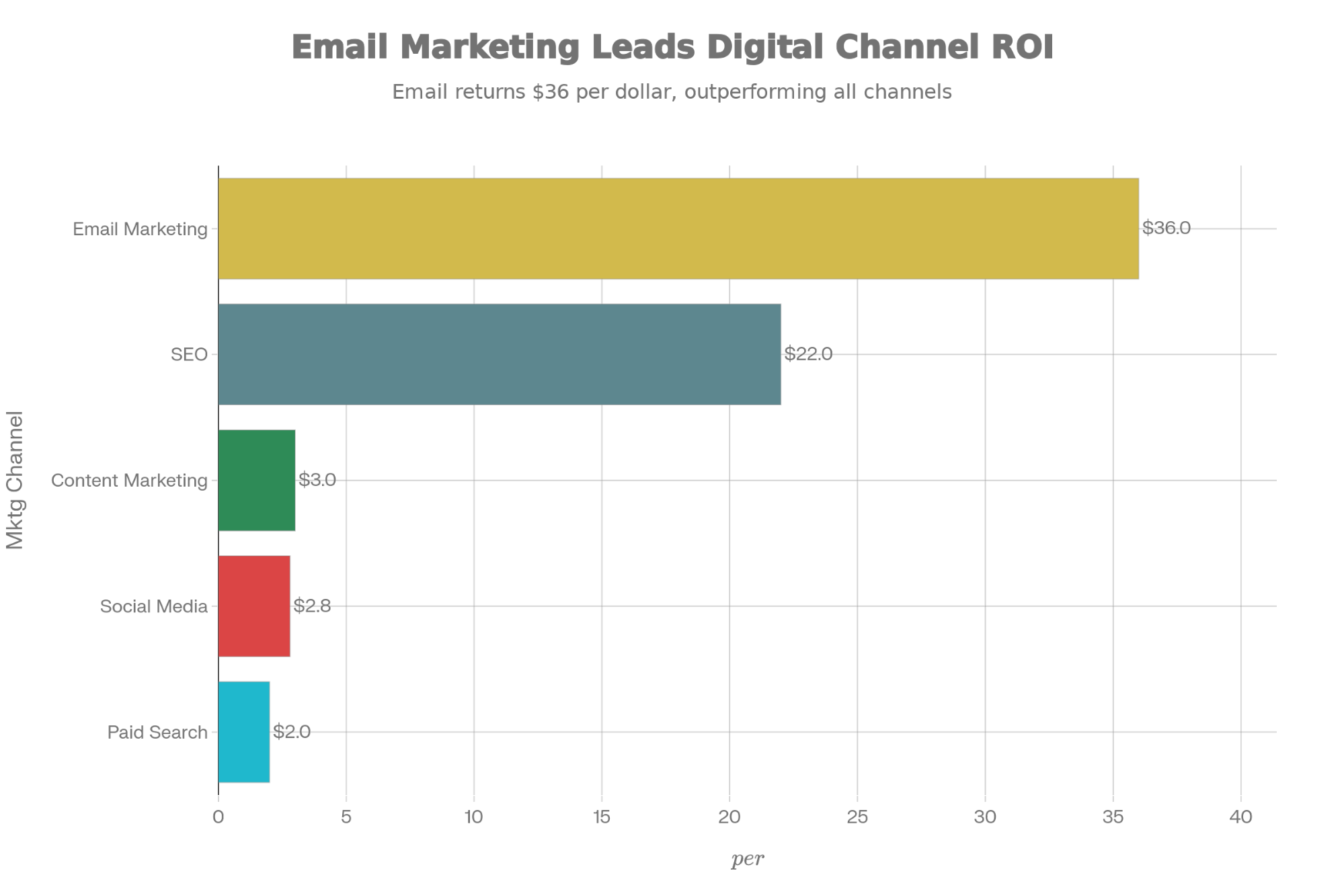
- Email: $36 per $1 spent
- SEO: $22 per $1 (high-end estimate; range $3-22)
- Content Marketing: $3 per $1
- Paid Search (PPC): $2 per $1
- Social Media: $2.80 per $1
Why email dominates ROI rankings
- Zero Marginal Cost: Sending to 10,000 vs. 100,000 subscribers incurs negligible incremental platform fees (0.1-0.5¢ per email), unlike paid ads ($0.50-$5 per click)
- Owned Audience: Email lists are proprietary assets; social media "followers" are platform-dependent and subject to algorithm changes reducing organic reach
- Permission-Based: Opt-in subscribers demonstrate intent; 81% of consumers prefer promotional content via email vs. other channels
- Automation Leverage: Triggered emails (abandoned cart, welcome series) generate $3.07-$2.35 revenue per recipient despite minimal marginal effort
Email’s 16:1 ROI advantage over paid search drives budget reallocation, not just incremental spend. Even modest reallocations (1–3% of digital budgets) translate into hundreds of millions in platform demand.
Optimal frequency economics
- Best cadence: 5–8 emails/month
- ROI at optimal frequency: $48 per $1
AI-driven send-time optimization now individualizes cadence at the subscriber level, increasing revenue per user without raising unsubscribe rates.
Automation As a Revenue Multiplier
| Automation type | Revenue per recipient |
|---|---|
| Abandoned cart | $3.07 |
| Welcome series | $2.35 |
| Browse abandonment | $0.95 |
| Post-purchase | $0.38 |
Automation adoption is projected to reach 65–70% of SMBs and 90%+ of enterprises by 2026. Each percentage-point increase adds $150–200M to total addressable market by lifting contract values and send volume.
Public Company Revenue Anchors Validate Market Size
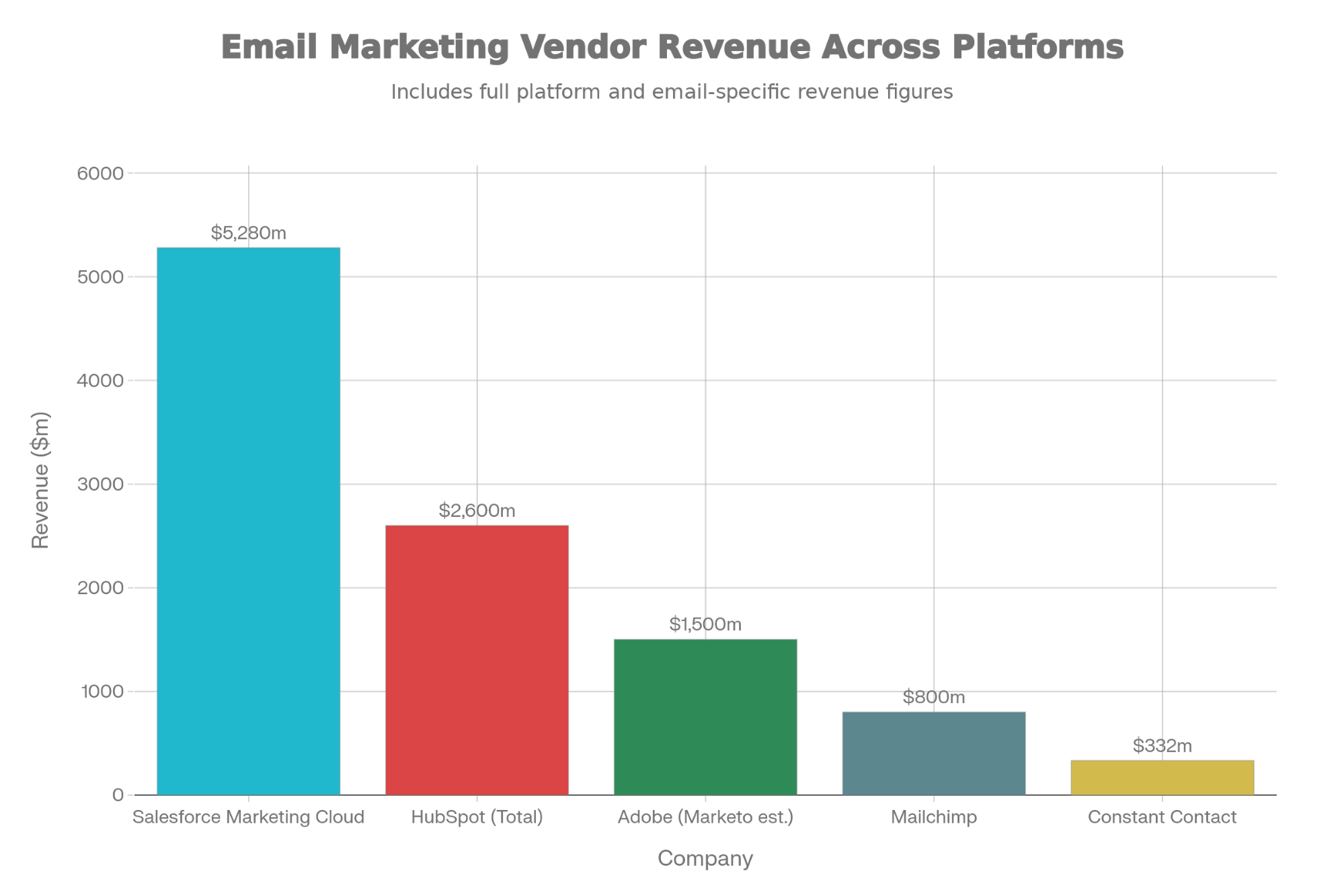
- Salesforce Marketing Cloud: ~$1.8–2.2B email-related revenue, +7.5% YoY
- Adobe Marketo: ~$600–800M, growing ~12%
- HubSpot Marketing Hub: ~$800M–1.2B, growing 18–25%
- Mailchimp: ~$700–800M, flat but largest SMB share
- Constant Contact: ~$332M, steady 3–5% growth
Together, top vendors capture 40–50% of total spend, mathematically validating a $14–18B market, not speculative $25B+ claims.
Structural Growth Drivers Through 2026 (With Operational Consequences)
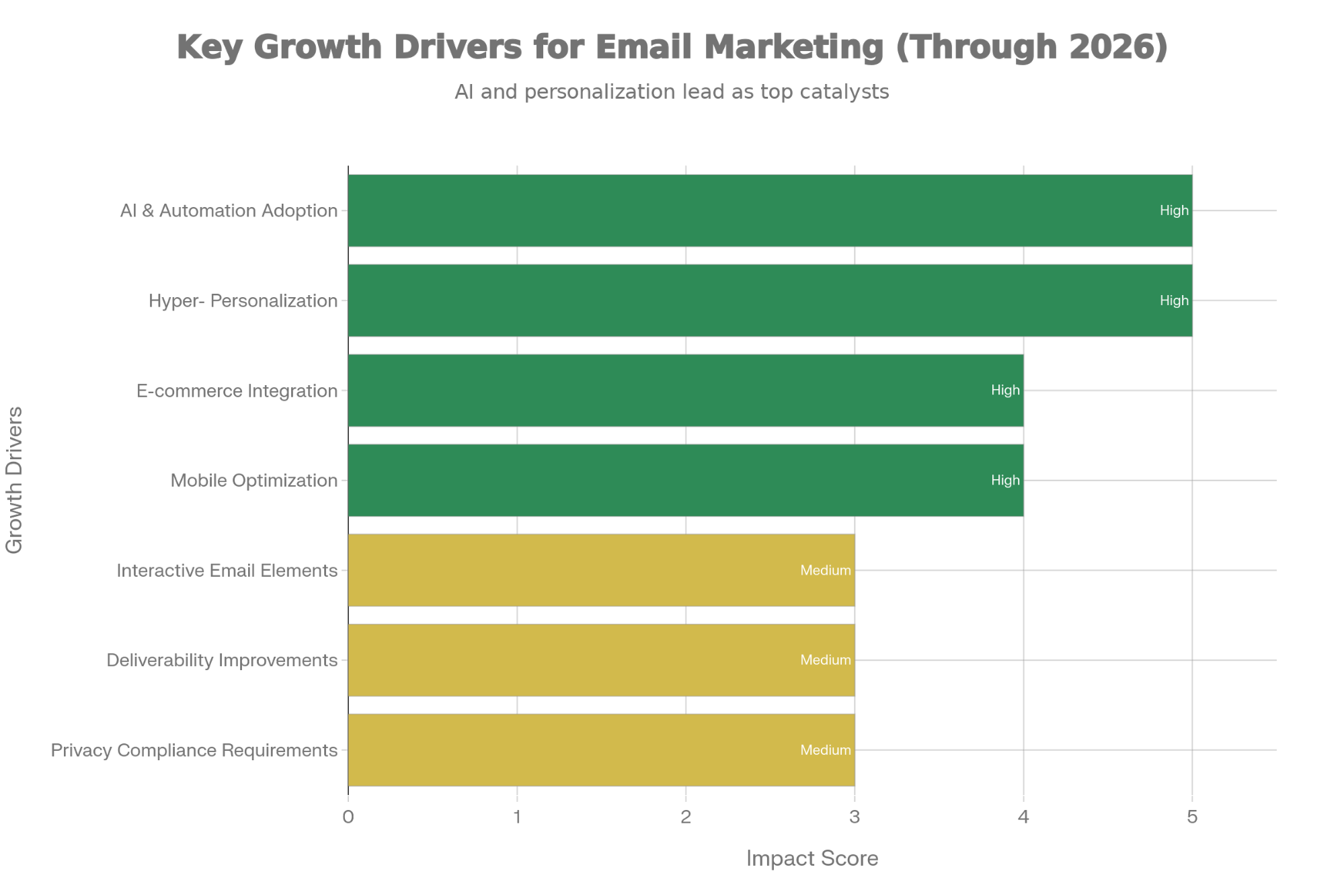
AI and machine learning integration
63% adoption today → 75–80% by 2026
AI reduces campaign production time by 40–60%, allowing the same teams to manage 2–3× more workflows. Vendors monetize these gains through tier upgrades rather than user growth.
E-commerce and transactional email
Email drives 4.24% of traffic to purchase, versus 0.59% for social. As e-commerce GMV rises, email spend scales mechanically as a fixed percentage of revenue, adding ~$2.7B by 2026.
Personalization and dynamic content
Adoption rises from 62% to 75–80%, driving $800M–1.1B via premium tiers and data integrations. Click-based signals increasingly replace open rates as Apple MPP reshapes analytics.
Mobile optimization
Mobile opens exceed 65% by 2026. Platforms without mobile-native editors lose 10–15% of customers annually, making mobile support a retention requirement rather than a growth lever.
Privacy and deliverability
Compliance creates $400–600M in tool and service demand, offsetting $300–500M in tracking friction.
In this environment, list quality becomes economically critical. Tools such as VerifiedEmail help mitigate deliverability and compliance risk by verifying addresses, detecting traps, validating domains, and reducing bounce rates before campaigns are sent—directly protecting sender reputation and ROI.
What Most Forecasts Get Wrong
- Conflating software revenue with the total market
- Ignoring public company revenue as validation
- Extrapolating early-stage growth indefinitely
- Treating AI as pure upside without service cannibalization
- Overlooking the SMB adoption ceiling
This report explicitly corrects for each of these errors.
What Can Be Stated With High Confidence About 2026
- The email marketing market will reach $14–18B, with $16.5B most likely
- AI adoption will exceed 75% of marketers
- ROI will remain above $30 per $1 spent
- SMB and mid-market growth will outpace enterprise
- Mobile will account for 65%+ of opens
- Top vendors will exceed 50% market share
As inbox competition tightens and deliverability rules harden, accurate verification and list hygiene become inseparable from performance. Platforms aligned with this reality—such as VerifiedEmail, developed in 2024 with 99% precision verification and scalable bulk cleaning—are structurally positioned to benefit from the same forces driving the market forward.
Verify 200 emails for free. For lists over one-million emails, we will beat the price of any competitor, guaranteed.