

Klaviyo Deliverability Issues: What’s Breaking Your Flows & How To Fix It
If there’s one thing an email marketer dreads, it’s email deliverability issues. Sometimes, even if you have the correct flows set up in Klaviyo, invalid email addresses can silently sabotage performance, causing unexpected bounces, lower open rates, and declining click rates.

How Klaviyo Deliverability and Flows Work
One thing you should know about Klaviyo deliverability is its reputation-based nature. This means that email providers decide whether your messages are worth delivering to the recipients based on a number of factors. Some of these factors include your sending history, engagement metrics, and domain/IP reputation. Every email you send, regardless of the flow, contributes to this reputation.
It’s important to implement email verification for Klaviyo because the platform doesn’t automatically verify email addresses whenever you add or sync new contacts. This means that contacts with typos, disposable inboxes, role addresses, catch-alls, or invalid MX records can enter your list and slowly impact your reputation over time.
How Invalid Emails Cause Klaviyo Flow Issues
Once you send emails to invalid or undeliverable contacts (like mistyped, fake, or non-existent email addresses), Klaviyo automatically suppresses these profiles.
A contact becomes suppressed if they:
- Hard bounce (the address doesn’t exist)
- Mark your email as spam
- Manually unsubscribe
- Are added to a suppression list during import
Once suppressed, skipped flow steps in Klaviyo happen, meaning the platform won’t send emails to that contact again. This is a mechanism designed to protect your sender reputation.
It’s important to note that this suppression happens after damage has already been done.
When you send emails through Klaviyo, inbox providers like Gmail and Yahoo evaluate your sending domain and/or IP address reputation. They don’t judge each email in isolation. They judge you as a sender based on overall behavior.
So if you:
- Send to invalid or risky email addresses via Klaviyo
- Generate too many hard bounces
- Receive spam complaints
- Send to disengaged users
Inbox providers lower your sender reputation score.
When your reputation declines, inbox providers become more cautious with all emails sent from that domain or IP, even the ones going to perfectly valid, engaged subscribers.
That means your emails to loyal customers may land in spam, causing open rates to drop, click rates to decline, and revenue from flows to decrease. At that point, it’s easy to assume something’s wrong with your flow logic. But in many cases, the real issue isn’t the automation itself, but your list quality and sender reputation working against you.
That’s how low-quality email addresses in Klaviyo damage your credibility as a sender. In a way, email reputation works similarly to a credit score. If you default on several loans (bounce repeatedly), your credit score drops. Once your score drops, banks become cautious with all your future applications, not just the risky ones.
Real-World Impact on Klaviyo Automations
When you send emails to an undeliverable or invalid contact, they can cause Klaviyo automation issues, even if your flows are set up correctly. Here’s how it might look in your flows:
1. Welcome Flows
Someone signs up for your newsletter, but they mistyped their email (e.g., sarah@gmial.com or john@outlok.com.
While your welcome flow triggers and sends the email, it will hard bounce because the address doesn’t exist. Now:
- That subscriber never receives your onboarding sequence
- Your bounce rate increases as you send more emails to the contact
- Your sender reputation gradually declines
If this happens repeatedly, inbox providers start trusting you less, and even your real subscribers may begin receiving emails in spam.
So your welcome flow performance drops, even though nothing’s wrong with the flow itself.
2. Abandoned Cart Flows
If a shopper enters a disposable or invalid email at checkout, the recovery email gets sent but immediately bounces. The contact then gets suppressed. That means the shopper won’t receive follow-up reminders or discount emails, and the revenue opportunity disappears.
It might look like lower cart recovery performance, but the actual issue is that the email address was never reachable.
3. Re-engagement Flows
Re-engagement campaigns are usually sent to older subscribers, or people who haven’t opened or clicked your emails in a while. The problem is, these older contacts might contain outdated email information. Some may have abandoned their inboxes, others may have nonexistent work email addresses, or their accounts may have expired.
When you send a campaign to this group, some will hard bounce because the addresses no longer exist. As those bounces add up, overall engagement drops and your bounce rate goes higher.
Metrics that get distorted by bad data
Sending to bad or invalid contacts slowly kills your email deliverability by messing with your metrics. Even if some contacts never receive your emails, they still get included in the reports, making your open and click rates lower, and your bounce rates and Klaviyo suppressed contacts higher than they really are.
Using VerifiedEmail, you can detect disposable, role-based, or risky addresses before they enter these automations, preventing bounces and suppressed contacts from accumulating.
How to Improve Klaviyo Deliverability and Reduce Bounces in Klaviyo
Here’s how to improve email deliverability:
1. Authenticate your sending domain (SPF, DKIM, DMARC)
- In Klaviyo, go to Settings.
- Navigate to Domains → Add Domains. Add the SPF and DKIM records Klaviyo provides to your domain’s DNS.
- Go to Domains and Hosting. Set up a DMARC record (even a basic monitoring policy is better than none).
This tells inbox providers that Klaviyo is allowed to send emails on your behalf.
2. Clean your existing list before sending again
Export your main segments (especially older subscribers) and run them through a bulk email verification tool like VerifiedEmail.
Use VerifiedEmail’s DNS/MX + SMTP checks, disposable/role detection, and email scoring to identify risky addresses. This ensures that invalid emails, previously hard-bounced addresses, and temporary inboxes are removed before they affect your flows.
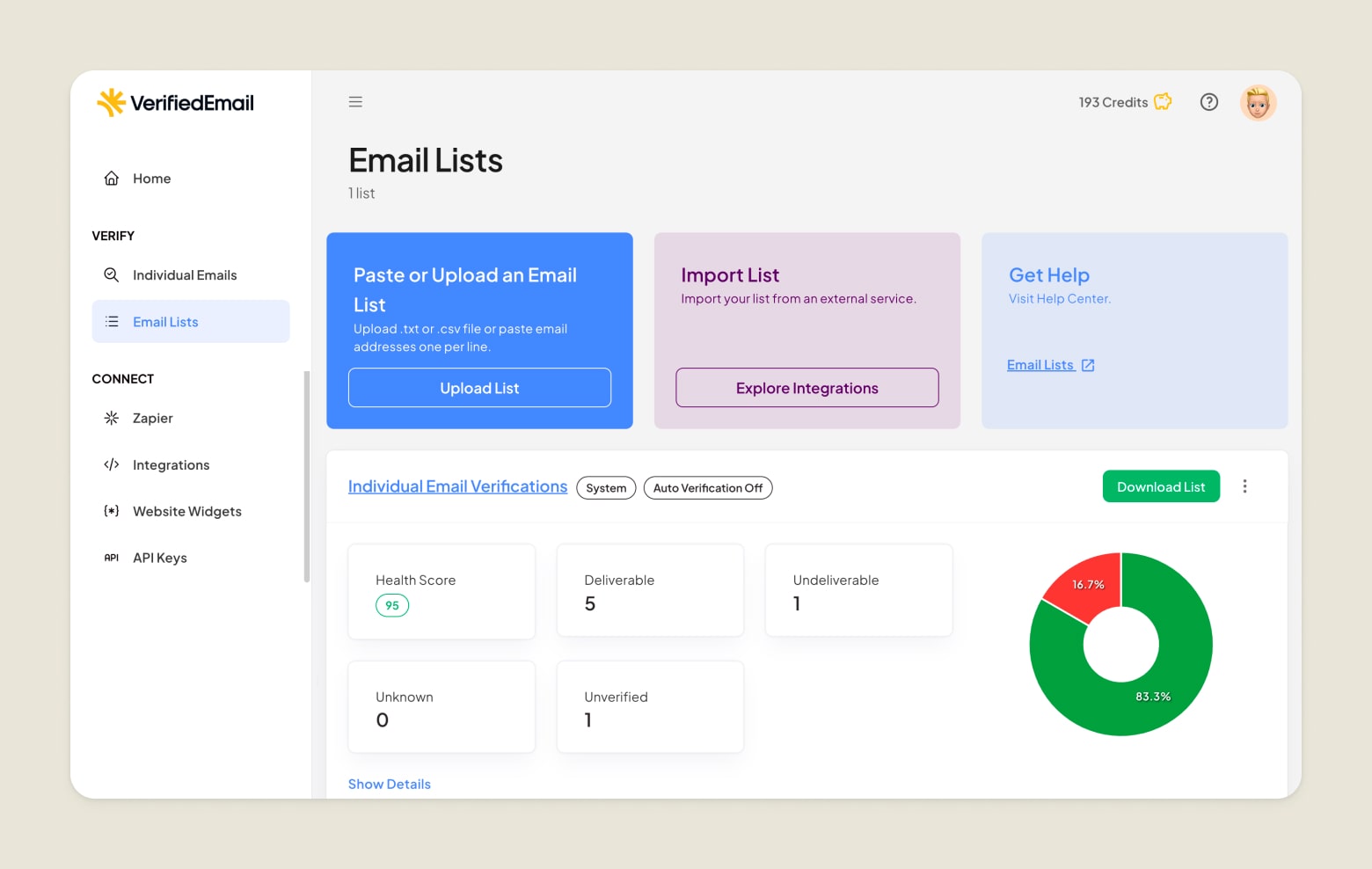
VerifiedEmail supports automatic Klaviyo email cleaning via integration. You can import existing lists from Klaviyo (or other platforms like HubSpot) and automatically clean them without manual effort.
Then re-import only the clean contacts into Klaviyo or suppress the risky ones to lower bounce risk.
3. Add real-time verification at signup
Use VerifiedEmail’s email verification API so every new subscriber is checked instantly when they sign up through your Klaviyo forms. Doing this will help block invalid or high-risk emails before they enter your list and mess with your flows.
4. Monitor deliverability signals inside Klaviyo
Check the following on a regular basis, either weekly or biweekly:
- Bounce rate (should stay under 2% according to email deliverability statistics)
- Increase in suppressed profiles
- Spam complaint rate
- Recipients skipped in flows
If you see bounce problems in Klaviyo or suppressed profiles increasing quickly, hold off sending large batches of emails and investigate before continuing.
VerifiedEmail allows you to be more vigilant with monitoring, automatically flagging risky addresses and giving you insights into flow interruptions before they happen.
Conclusion
Sometimes, Klaviyo deliverability issues are inevitable and beyond your control. However, when you know what’s causing problems in your flows, you can do something about them before they bring permanent damage to your reputation. With VerifiedEmail, you can verify new subscribers and clean existing lists to keep your automations running smoothly.
Verify 200 emails for free. For lists over one-million emails, we will beat the price of any competitor, guaranteed.