

Bouncer Review: How Accurate Is It for Email Verification
Bouncer (UseBouncer) is an email verification tool focused on accuracy, privacy, and risk detection. It positions itself as a “secure and caring” solution with features like toxicity scoring and compliance-first infrastructure. In this review, we look at where it works well and where it falls short.

First Look at UseBouncer
Bouncer operates as a verification-first platform that combines standard email validation with additional layers like toxicity scoring and optional deliverability checks. Instead of just confirming whether an email exists, it aims to give more context around risk, helping teams decide which contacts are safe to keep before sending campaigns.
Who Bouncer is built for
Bouncer is commonly used by SaaS teams, agencies, and outbound teams. It is especially relevant for European businesses that prioritize GDPR verification compliance and secure data handling. Typical use cases include bulk verification, API validation, and form protection.
Pricing and credits
Bouncer uses a credit‑based, pay‑as‑you‑go model with volume discounts and credits that never expire (unlike some popular competitors, such as Kickbox).
Typical one‑time bundles are:
- 1,000 credits – $8 (about $0.008 per email)
- 5,000 credits – $35 (about $0.007 per email)
- 10,000 credits – $60 (about $0.006 per email)
- 50,000 credits – $250 (about $0.005 per email)
- 100,000 credits – $400 (about $0.004 per email)
- 250,000 credits – $750 (about $0.003 per email)
- 500,000 credits – $1,250 (about $0.0025 per email)
- 1,000,000 credits – $2,000 (about $0.002 per email)
Minimum purchase is 1,000 credits, and there are optional monthly subscriptions at fixed volumes if you prefer a recurring plan.
Bouncer’s Standout Capabilities
Verification engine and accuracy claims
Bouncer supports bulk, real-time, and single-email verification. It provides detailed result categories instead of simple pass/fail outputs, helping teams better assess email quality. The platform promotes high accuracy and low “unknown” rates.
Toxicity, risk and engagement signals
A key differentiator is Bouncer’s Toxicity Check, which scores contacts based on risk factors like spam traps, complaints, and widely circulated emails. This adds an extra layer beyond standard verification.
Bouncer also offers a Deliverability Kit with inbox placement testing and basic monitoring tools, extending its functionality beyond list cleaning.
Privacy, security and multi-tenant controls
Bouncer emphasizes privacy and compliance, with EU-based infrastructure and GDPR alignment. It also supports multi-organization setups, making it suitable for agencies and teams managing multiple clients.
What Bouncer Gets Right
Users consistently report that Bouncer is accurate for everyday verification tasks. Many see clear improvements in bounce rates after cleaning their lists, particularly when working with older data.
The interface is simple and easy to navigate, allowing teams to run verifications without technical setup. Customer support is also frequently mentioned as responsive and helpful.
Another strong point is trust. Bouncer’s focus on data protection and compliance is especially valued by European companies.
Where Bouncer fits particularly well
Bouncer works well for agencies that need structured workflows and client-friendly reporting. It is also a strong fit for compliance-sensitive environments where data security is a priority.
Teams that want additional insights, such as toxicity scoring and form-level protection, will benefit more than with basic verification tools.
Limitations to Watch Out For
Real-world accuracy vs marketing claims
While Bouncer promotes high accuracy, real-world results still include trade-offs. Some valid emails may be flagged as risky, and some invalid emails may still pass through.
“Unknown” or borderline results remain a challenge and require manual decision-making.
Speed, scale and performance trade-offs
Bouncer performs well at moderate volumes, but at very large scale, processing speed may be slower compared to high-throughput tools. This can impact workflows for teams handling large datasets.
Deliverability tooling scope
Although Bouncer offers additional tools like its Deliverability Kit, it remains primarily a verification platform. It does not provide full deliverability monitoring or continuous reputation tracking.
Integrations and workflow gaps
Bouncer supports API and integrations, but some workflows still require manual handling. This can introduce inefficiencies for teams with more complex setups.
When Bouncer Is a Good Fit – And When It Falls Short
Bouncer is a strong choice if…
Bouncer is a good option if you value accuracy, additional risk signals, and strong data protection. It works well for agencies, SaaS teams, and European businesses.
You may outgrow Bouncer if…
Bouncer may be less suitable if you need very high processing speed, lower cost at scale, or deeper deliverability analytics. Teams that depend heavily on deliverability performance may need more than verification alone.
Bouncer’s Best Alternative: VerifiedEmail
VerifiedEmail is an email verification tool that covers the same core use cases as Bouncer, including bulk verification, real-time validation, and API-based workflows.
The key difference is how results are handled. Bouncer provides detailed outputs, including toxicity and risk signals, but many cases still require interpretation. VerifiedEmail focuses on making those decisions more straightforward, with clearer classifications that are easier to act on without additional filtering or analysis.
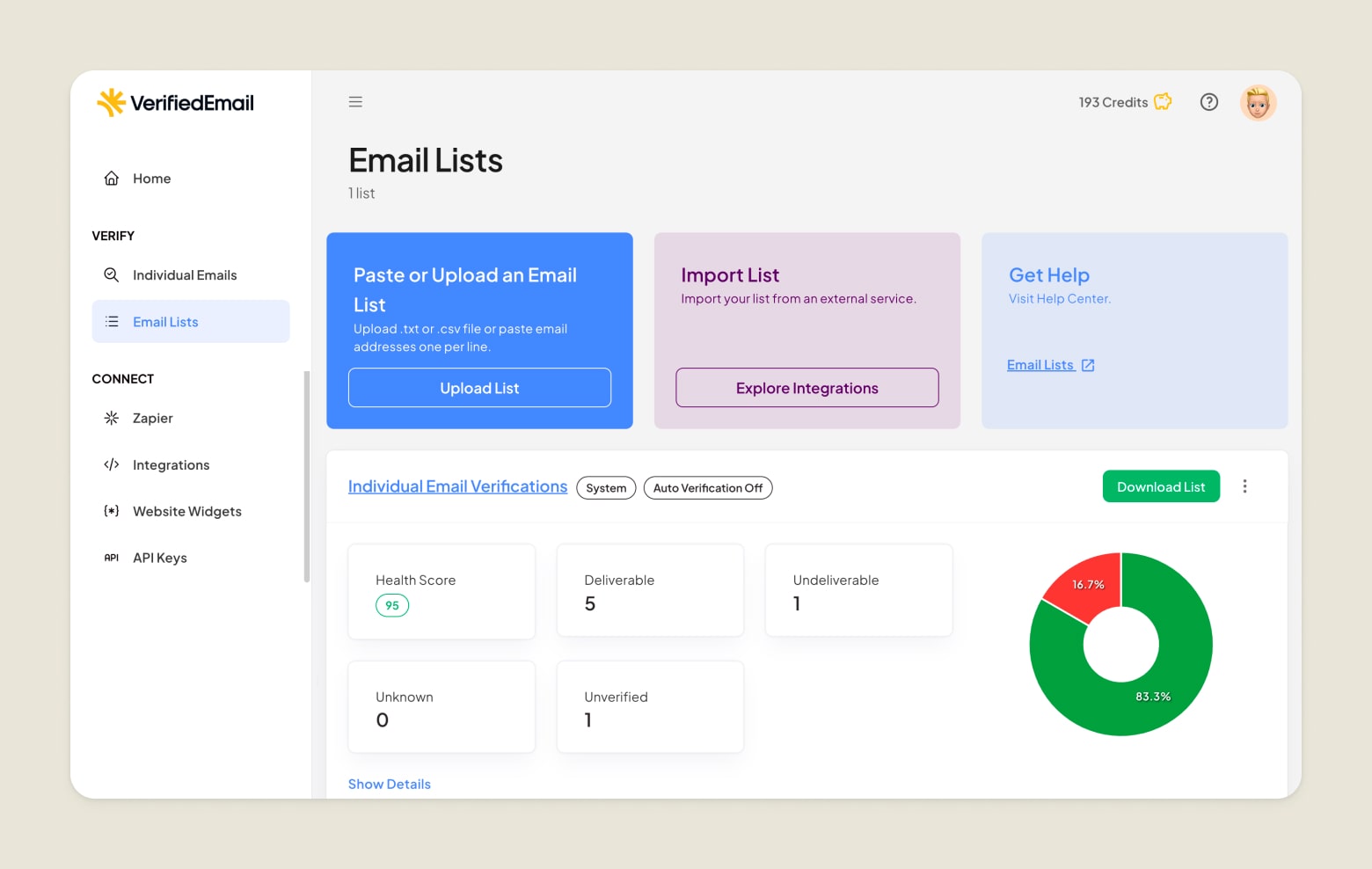
This makes VerifiedEmail a better fit for teams that want a more direct verification workflow. Instead of working through multiple risk layers, you can move faster from verification to sending, which is especially useful in high-volume or time-sensitive environments.
Bouncer vs VerifiedEmail: Pros and Cons
| Bouncer | VerifiedEmail | |
|---|---|---|
| Pros |
|
|
| Cons |
|
|
Which should you choose?
➡️ Choose Bouncer if you want a verification tool with strong accuracy, additional risk signals, and a focus on privacy and compliance.
➡️ Choose VerifiedEmail if you need a simpler, cost-efficient solution that scales well and fits into ongoing deliverability workflows.
Final Thoughts
Bouncer is a well-rounded email verification tool that stands out for its accuracy, toxicity scoring, and compliance-focused approach. It performs well for standard list cleaning and offers useful additional insights.
However, like most verification tools, it has limitations around edge cases, scale, and full deliverability visibility. For teams that want verification tightly connected to long‑term deliverability strategy and budget at scale, VerifiedEmail can be a more practical alternative.
Read more:
Verify 200 emails for free. For lists over one-million emails, we will beat the price of any competitor, guaranteed.