
Every 3–6 months, or immediately after a big influx of new contacts.


6 Best Email List Hygiene Services To Keep Your Lists Clean
Your email list is a living thing. Ignore it too long, and it decays. Invalid addresses pile up, bounce rates climb, and deliverability tanks. The fix? Regular maintenance with a good email list hygiene service. I’ve worked with many of these tools—some great, some meh. These six are the ones I’d actually recommend.Updated on October 11, 2026
Quick Comparison Table
| Service |
|---|
| VerifiedEmail |
| ZeroBounce |
| NeverBounce |
| Kickbox |
| EmailListVerify |
| Bouncer |
| Free Credits | Price per 1,000 | Accuracy | Real-Time API | ESP Integrations | GDPR Compliant |
|---|---|---|---|---|---|
| 200 | $7 | 99% | Yes | Yes | Yes |
| 100/month | ~$8 | 98% | Yes | Yes | Yes |
| None (Demo only) | ~$8 | 99.9% delivery | Yes | Yes | Yes |
| 100 | $10 | ~99% | Yes | Yes | Yes |
| 100 | $4 | ~98% | Yes | Yes | Yes |
| 100 | $8 | 99.5% | Yes | Yes | Yes |
1. VerifiedEmail — Fast, Unpretentious, and Built by People Who’ve Been There
Some tools feel like they were built in a lab. VerifiedEmail feels like it was built during a panic, by someone cleaning a list at midnight before a product launch—and realizing the other tools were either too slow, too expensive, or too smug.
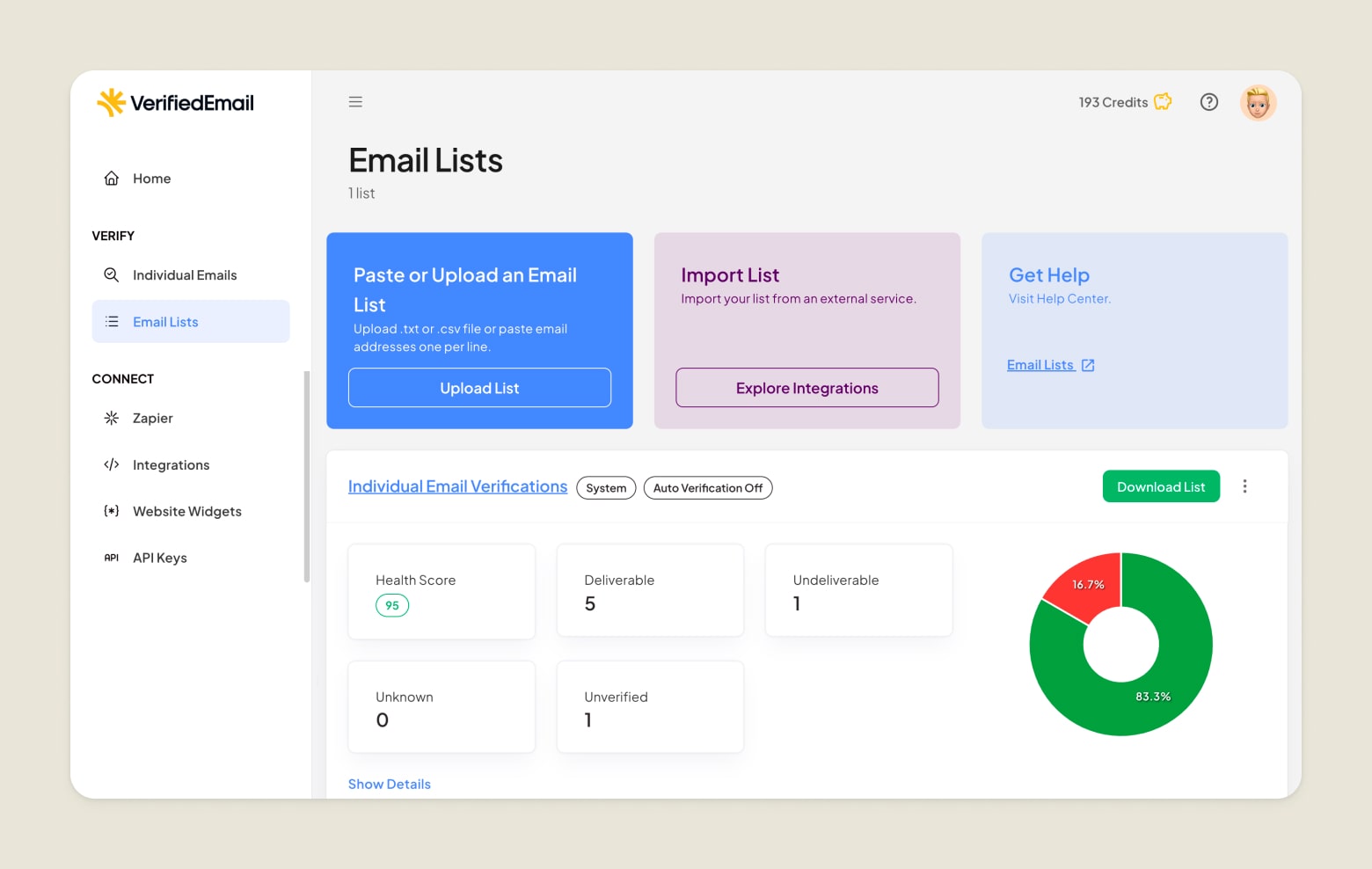
And I say that with love. There’s no “AI engagement score.” No glossy dashboard pretending to be a CRM. You upload your list. It tells you what’s dead, what’s risky, and what’s clean. Done.
I’ve used it on everything from Shopify exports to 5-year-old lead gen lists that looked like data graveyards. VerifiedEmail always catches more than I expect. Disposable emails. Spam traps. Even duplicates that slipped through CRMs I thought were solid.
They also have something I now won’t live without: continuous cleanup. You set it up once, and it rechecks your list every day. No upload. No download. Just quiet maintenance in the background—like a decent sleep schedule for your email list.
Why I keep going back:
- It doesn’t try to do too much.
- It doesn’t charge me for “unknowns” or waste my time with marketing fluff. It’s the only tool I’ve used that didn’t make me second-guess the results.
It’s not built for teams that want to analyze a contact’s engagement score over six months and cross-reference with timezone activity. It’s built for people who just want a list that works.
2. ZeroBounce — Extra Context When You Need It Most
ZeroBounce feels like it was designed for teams who want more than just “valid or not.” It gives you behavioral scoring, activity history, even geolocation tagging if that’s your thing.

I remember using it for a reactivation campaign—an old lead list that hadn’t seen sunlight in over a year. ZeroBounce gave each contact a kind of “engagement pulse,” letting us focus on people who were more than just technically reachable. That one tweak? Lifted our open rate from 14% to 21%—no exaggeration.
It’s not cheap, but if you’ve got serious volume or you’re answerable to a metrics-hungry CMO, this tool gives you the ammo you need.
Highlights:
- Validates AND enriches
- Gives insight into user activity
- Best for marketers who love segmentation
3. NeverBounce — Clean Huge Lists Without Losing a Weekend
Some tools slow to a crawl once you throw more than 100k contacts at them. NeverBounce just shrugs and gets to work.

We once used it to clean a list of 750,000 emails—an absolute junk drawer collected from webinars, giveaways, and old CRMs. It finished in under a couple hours. Better still, the reporting was clear: we cut 9% bad data and almost 4% risky email addresses.
It’s especially useful if you work with clients and don’t have time to baby every list. The auto-sync feature with platforms like Mailchimp or HubSpot? Lifesaver.
Best when:
- You’re managing massive or aging lists
- You want to automate cleanup with minimal fuss
- Speed matters
4. Kickbox — When Deliverability Is Your North Star
Kickbox isn’t just about whether an address exists. It’s about whether it matters.

That sounds a little lofty, but hear me out. This tool doesn’t stop at hygiene—it pushes into territory most ignore: inbox placement, blocklist monitoring, and even spam filter diagnostics.
I used it to prep a Black Friday email blast. The hygiene check was solid, but the real win? Their testing dashboard showed we were getting flagged by Outlook because of an outdated SPF record. One DNS tweak later—problem solved. That campaign pulled in 16% more revenue year-over-year.
You’ll like it if:
- You obsess over sender reputation
- You need pre-send testing beyond email list cleaning
- Your audience spans corporate inboxes
5. EmailListVerify — The Reliable Budget Option
Let’s not overcomplicate it: sometimes you just need a tool that works, costs very little, and won’t try to upsell you halfway through a job. That’s EmailListVerify.
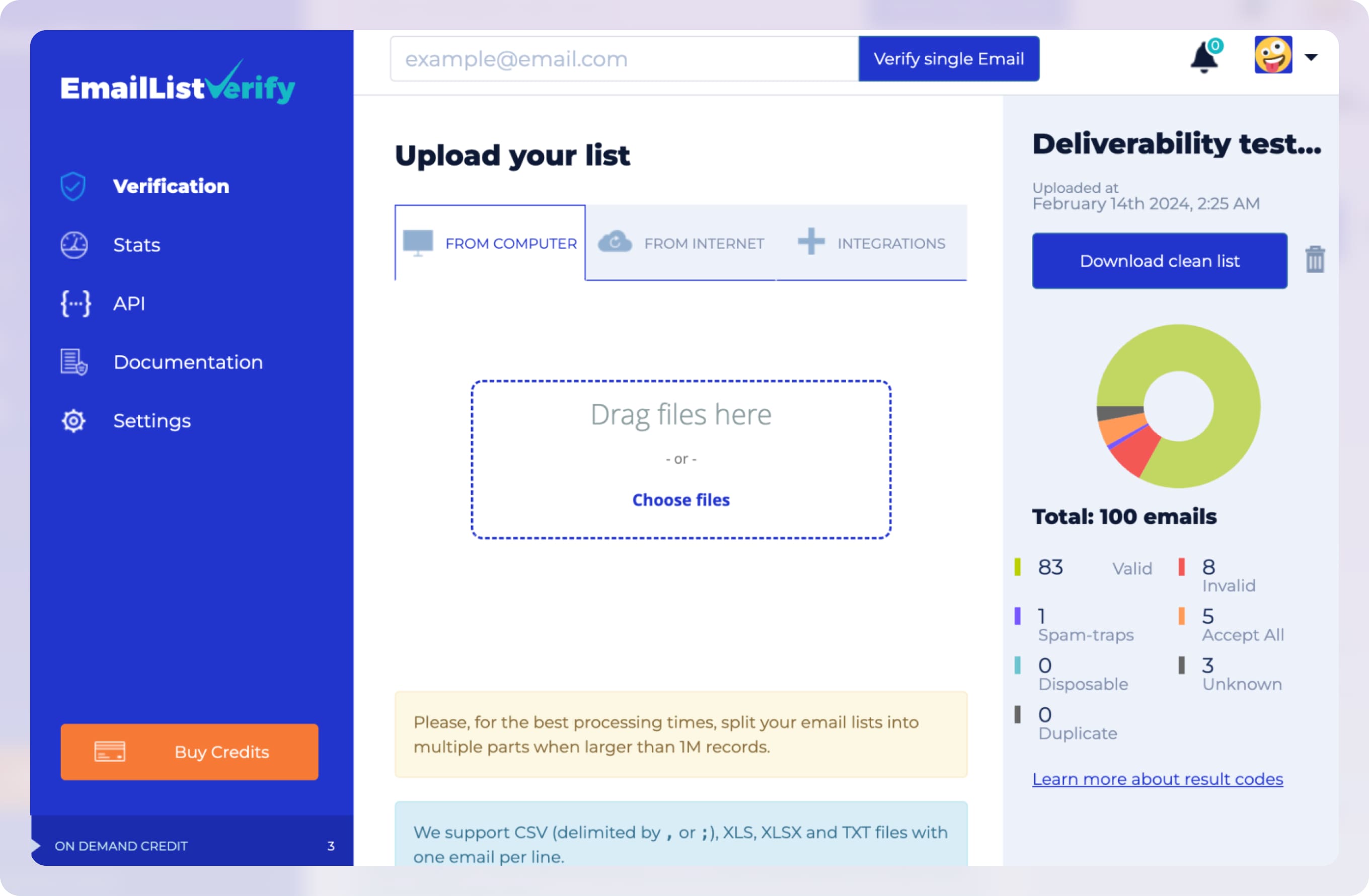
I’ve used it for early-stage founders and solo marketers scraping together lists from Airtable exports and Typeform leads. It gets the job done. It’s not fancy. But the results are consistent, and the UI is straightforward enough that you don’t need a tutorial to get started.
It also gives you just enough extras—spam trap detection, MX record validation, role account spotting—to feel like you’re not cutting corners.
Who it’s for:
- Startups, freelancers, and folks watching their budget
- Teams cleaning one-off lists
- People who want fast results without fluff
6. Bouncer — Quiet, Clean, and Incredibly Respectful of Data
Bouncer’s the one you might not hear about as much—but once you do, you kind of wonder why it took so long.

It’s privacy-first (truly—GDPR-compliant to the letter), calm in its UX, and surprisingly smart in how it handles edge cases. We ran a small batch of high-risk addresses—stuff flagged by other email verification tools as “unknown”—and Bouncer not only resolved 80% of them, it auto-corrected nearly two dozen obvious typos. You know the ones: gmal.com, yaho.co… we’ve all seen them.
They also auto-delete your data after use unless you say otherwise. That’s a trust move.
Great for:
- EU companies with strict compliance needs
- Sensitive or high-risk datasets
- Users who appreciate thoughtful UI design
What Happens When You Don’t Clean Your List?
| Problem | ❌ Unclean List | ✅ Clean List |
|---|---|---|
| Bounce Rate | 6–12% | <1% |
| Spam Complaints | Common | Rare |
| Sender Reputation | Drops fast | Stays strong |
| Open Rate | Flatlines | Rebounds |
| Campaign ROI | Diminished | Noticeably better |
One client once told me, “I thought we had an email strategy problem. Turned out we had a list problem.” That stuck with me.
Conclusion
Email list hygiene isn’t glamorous, but it works. There’s no award for having the cleanest list. Nobody notices when your bounce rate is 0.4% instead of 3.7%. But you’ll notice. In your results. In your sender score. In your ESP not flagging your next campaign.
Pick the tool that fits your size, budget, and brain. Don’t overthink it. Just clean your list before it starts rotting your whole strategy. Start with VerifiedEmail if you’re not sure. Or whatever fits. Just start.
💡 Read more: Top 9 Affordable Bulk Email Verification Tools.
FAQs
No. Real-time is great for signup forms, but you still need to clean the full list regularly.
Not exactly. Cleaning removes bad data. Pruning removes inactive (but valid) users. You need both.
Rising bounce rate. If it creeps above 2%, clean the list. Don’t wait.
Clean your email lists today.
Verify 200 emails for free. For lists over one-million emails, we will beat the price of any competitor, guaranteed.