

Choosing The Right Email Verification API: A Real-World Comparison
Picking the best email verification API isn’t about who has the flashiest homepage. It’s about who quietly protects your sender reputation when your data is messy, traffic is spiky, and edge cases show up at scale. This guide compares leading APIs side by side, and explains where each one actually shines.
Best Email Verification API: How to Actually Compare Them
Most roundups just list tools. If you’re responsible for deliverability and engineering, you need more than that.
When I evaluate a verify email API, I care about:
- Accuracy in the gray areas: How well the email verification API handles catch-all domains, old inboxes, and privacy-heavy providers. Unknown vs risky vs invalid split — and whether the email validator API charges you for unknowns.
- Latency and reliability: During signup, real-time checks shouldn't cause an extra 1-2 seconds of friction. You require a web API email verify call with timeouts and fallbacks that fail gracefully.
- Developer experience: Clean JSON responses, clear status codes, test/sandbox modes, and sane rate limits. SDKs or quality documentation for your primary languages at the very least.
- Bulk + automation: Both synchronous "is this address OK?" and asynchronous bulk jobs for recurring list cleaning should be supported by a reliable email verifier API. Polling or webhooks for job completion are advantageous.
- Price at your real volume: Cost per 1,000 or 1M verifications, how credits expire, and whether “unknown” results are charged.
- Security, privacy, and compliance: GDPR readiness, data residency options, and minimal logging of PII.
The ranking and comparison below follow that logic — not just who shouts “99% accuracy” the loudest.
The Top Email Verification APIs Compared
Below is a comparative look at eight leading options, with an emphasis on email verify API use in production rather than just marketing claims.
1. VerifiedEmail – best balance of accuracy, speed, and pricing
Originally designed as an internal validation system, VerifiedEmail now instantly verifies millions of addresses every day. Through a quick, adaptable API and webhooks, it combines continuous re-verification, bulk list cleaning, and real-time verification.
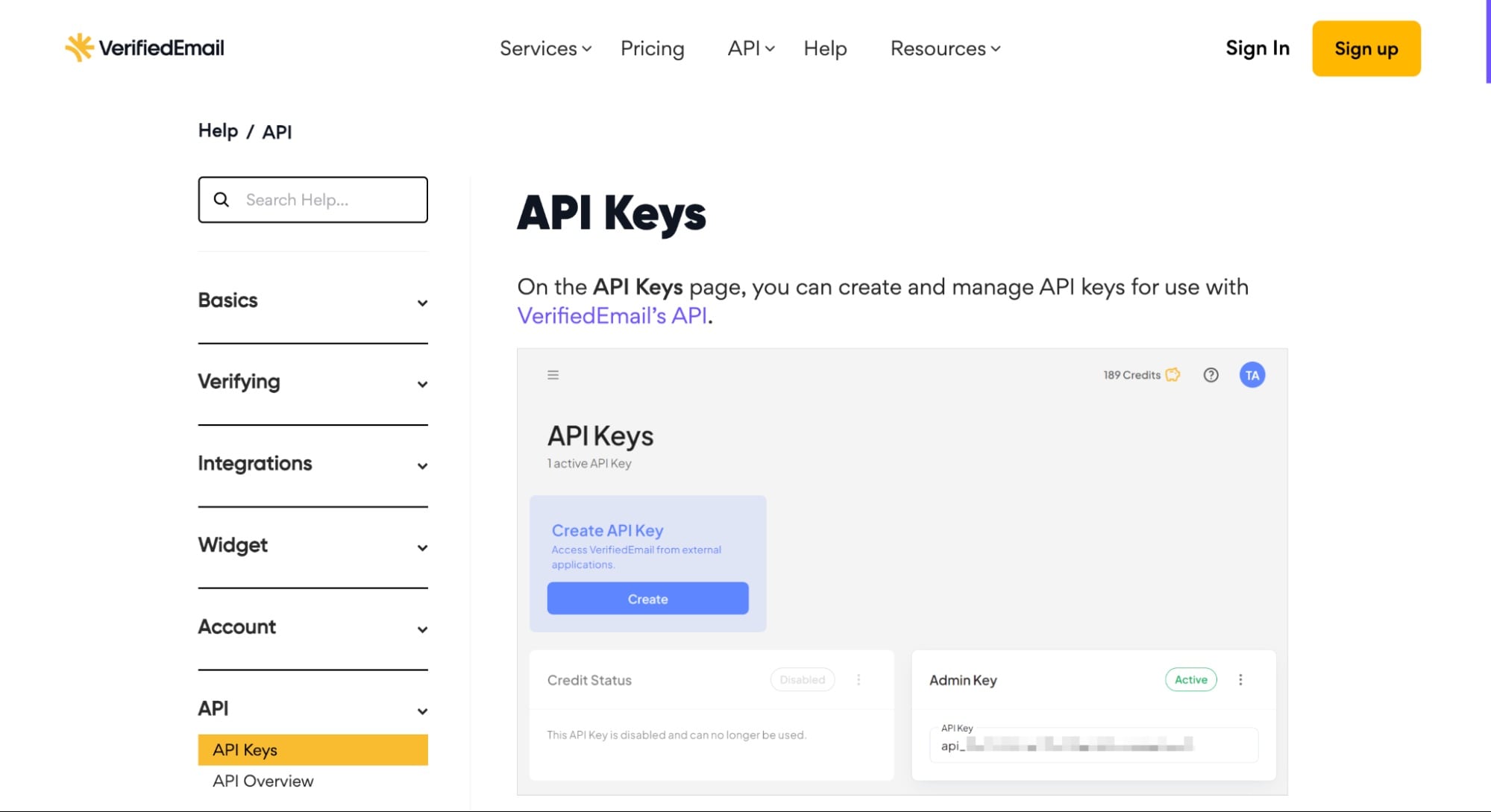
📌 Best for: Teams that care about deliverability as much as they care about latency and cost, such as high-volume marketers, ESPs, and SaaS products.
Why it ranks first:
- Real-time focus: A dedicated real-time verify email address API lets you validate at the point of entry (forms, widgets, custom flows) with “human-like verification built in,” so you catch typos and bad actors before they hit your list.
- 99% precision on bulk cleaning: The platform targets 99% precision when cleaning existing lists, including scoring data for questionable addresses.
- Continuous list maintenance: Continuous Cleanup auto-re-verifies lists and handles temporary issues (full mailboxes, intermittent servers) without you scripting your own cron zoo.
- Transparent, aggressive pricing: 200 free credits to start and a policy of beating competitor pricing on lists over 1M addresses gives you a very friendly cost curve at volume.
- Truly API-first, with flexible integrations and webhooks.
- Credits for an API email verification free trial (200 credits) that’s actually useful for a real test.
- Strong alignment with modern best practices — the blog on email verification best practices is written from exactly the angle an ops or growth team needs.
- Newer brand than legacy players like NeverBounce or ZeroBounce, so some teams will do side-by-side tests before switching.
- Benchmark data is still emerging in third-party roundups, although early comparisons already list VerifiedEmail among top email verification tools.
For many teams, especially those building product-led flows, VerifiedEmail effectively becomes the email validator API that sits between acquisition, CRM, and ESP — quietly catching problems before they become “deliverability issues.”
2. ZeroBounce – enterprise-grade features and enrichment
ZeroBounce API has been in “top tools” lists for years, and you’ll often see it framed as the zerobounce best email verification API in mainstream roundups. It offers a robust feature set: disposable detection, spam-trap detection, syntax checks, mail server validation, catch-all detection, and bulk verification.
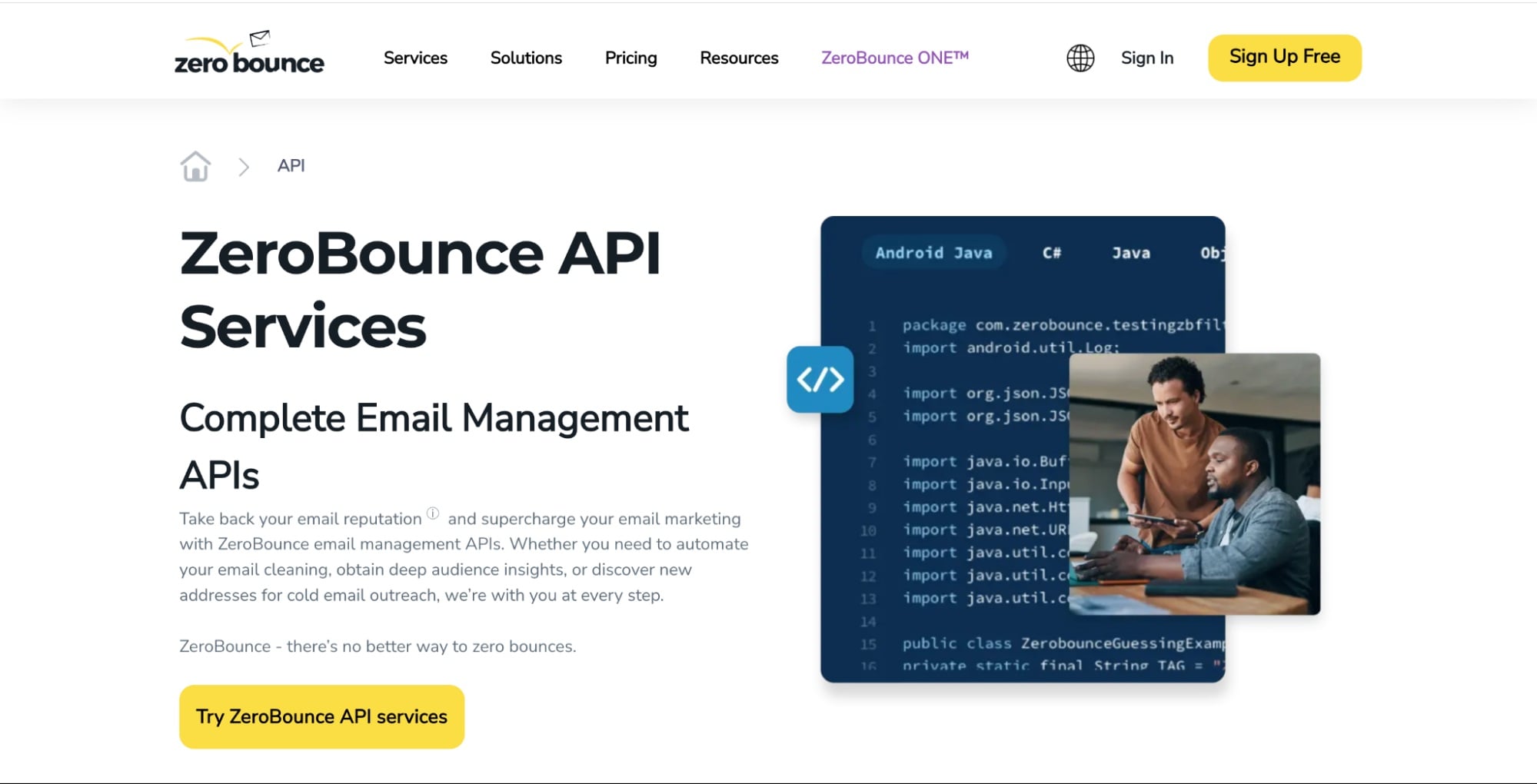
📌 Best for: Larger organizations that want verification plus enrichment and broad integrations.
- Full suite of email verification API features, including single and bulk verification, syntax validation, domain and DEA detection.
- Rich integration ecosystem with marketing platforms, CRMs, and ecommerce tools.
- Strong compliance posture and widely recognized brand.
- Pricing is typically higher per email than leaner alternatives.
- API responses and docs can feel heavier than they need to be if you just want a lean, developer-friendly validate email API.
If you’re an enterprise or agency and need that established name plus enrichment data, ZeroBounce is a strong candidate — but it’s rarely the cheapest choice at scale.
3. Kickbox – developer-friendly and battle-tested at scale
Kickbox is almost a default in a lot of dev discussions. It has a long history, strong documentation, and a mature email verification API.
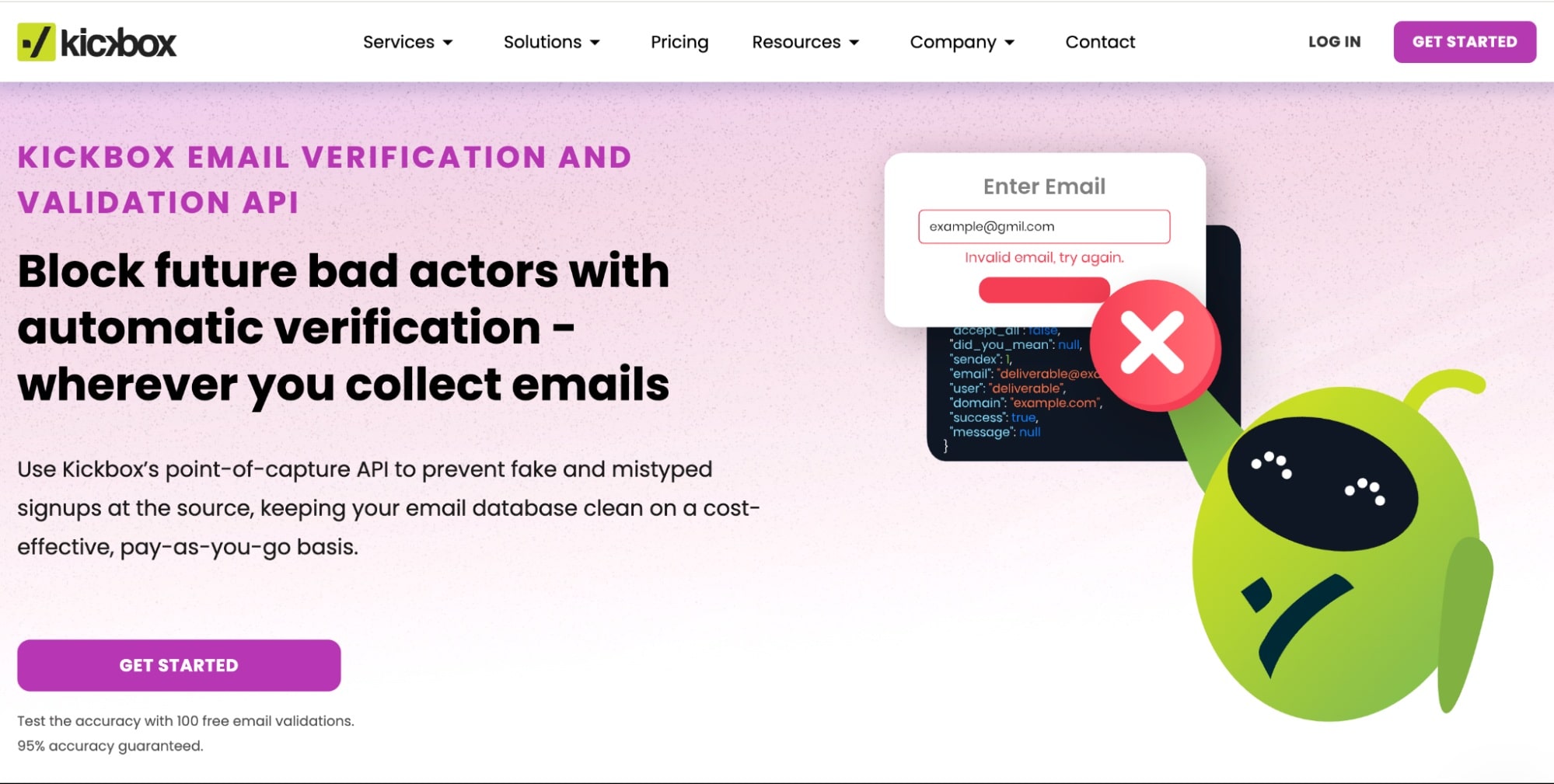
📌 Best for: Teams that need a reliable email verification API with clear results and a good free tier.
- A quick and accurate verification platform with both list cleaning and real-time API.
- Clear classification of deliverable, risky, and undeliverable addresses (including disposable, role-based, and catch-all).
- 100 free verifications as a starter, which works nicely as a sandbox.
- Good docs, SDK libraries, and case studies around API usage.
- Pricing isn’t the lowest at very high volumes.
- Accuracy is high, but some benchmarks show it slightly behind the most aggressive competitors on tricky datasets.
Kickbox is a safe, well-documented choice for an email verification API that your developers can quickly add to their projects and that your marketing team will know about.
4. Emailable – high accuracy and flexible pricing
The Emailable API is known for its quick verification and fair prices. Users like that it has a 99% delivery guarantee, 99.99% uptime, and you don’t pay for unknowns and duplicates most of the time.
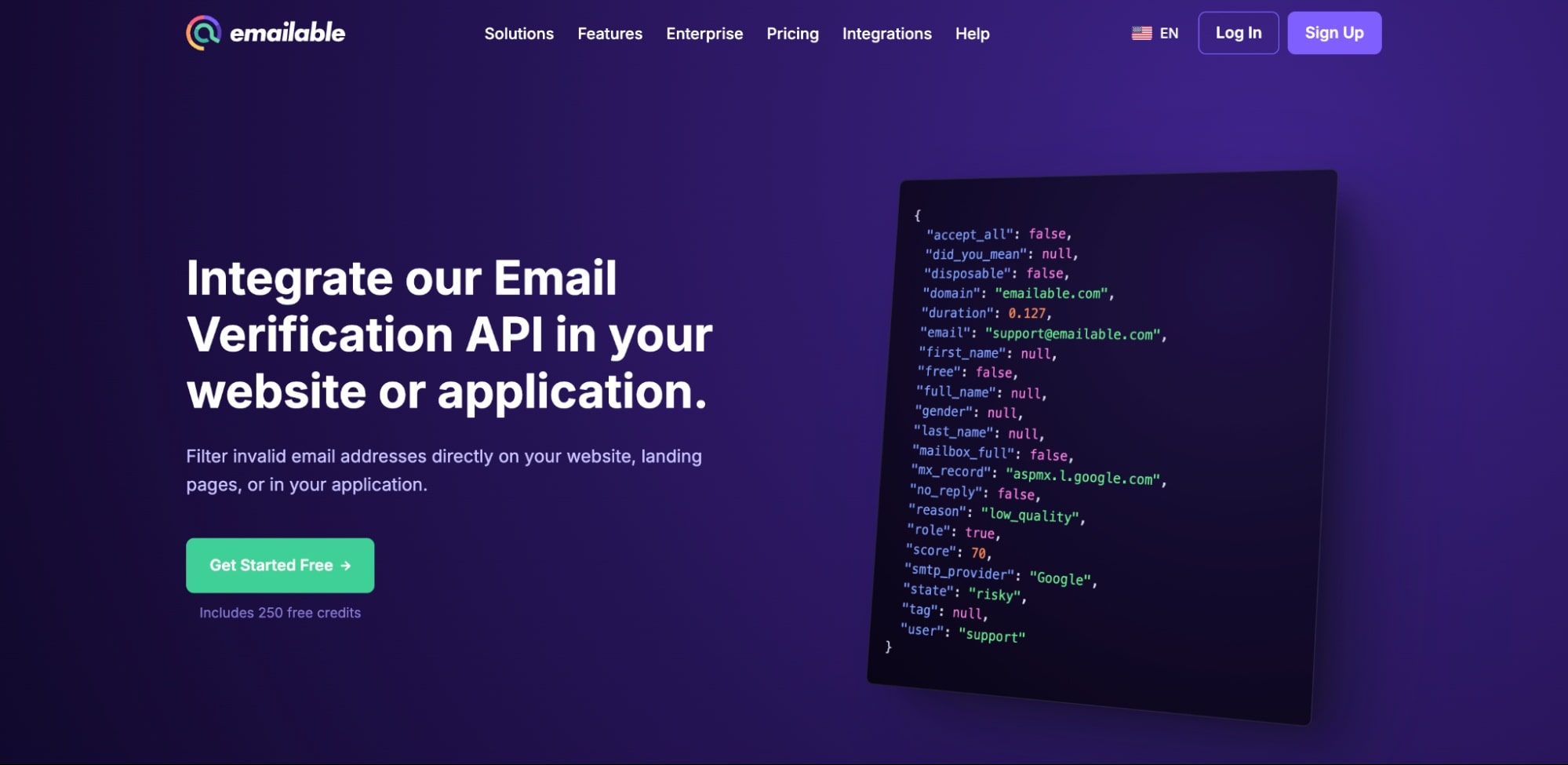
📌 Best for: Teams that want a balance of accuracy, speed, and pay-as-you-go pricing.
- Can check for spam and disposable email addresses, syntax and domain issues.
- Independent reviews say value for money is good, credits never expire and the refund policy is fair for unknowns.
- Developer friendly email verification API with simple integration paths.
- Some users say processing slows down for very large lists, and high volumes get expensive fast.
- SDK coverage isn’t as broad as some competitors, so you may have to lean more on raw HTTP integration.
If you’re doing periodic deep cleans and some real-time checks, Emailable is a mid-market option.
5. Bouncer – security-focused with strong credit policies
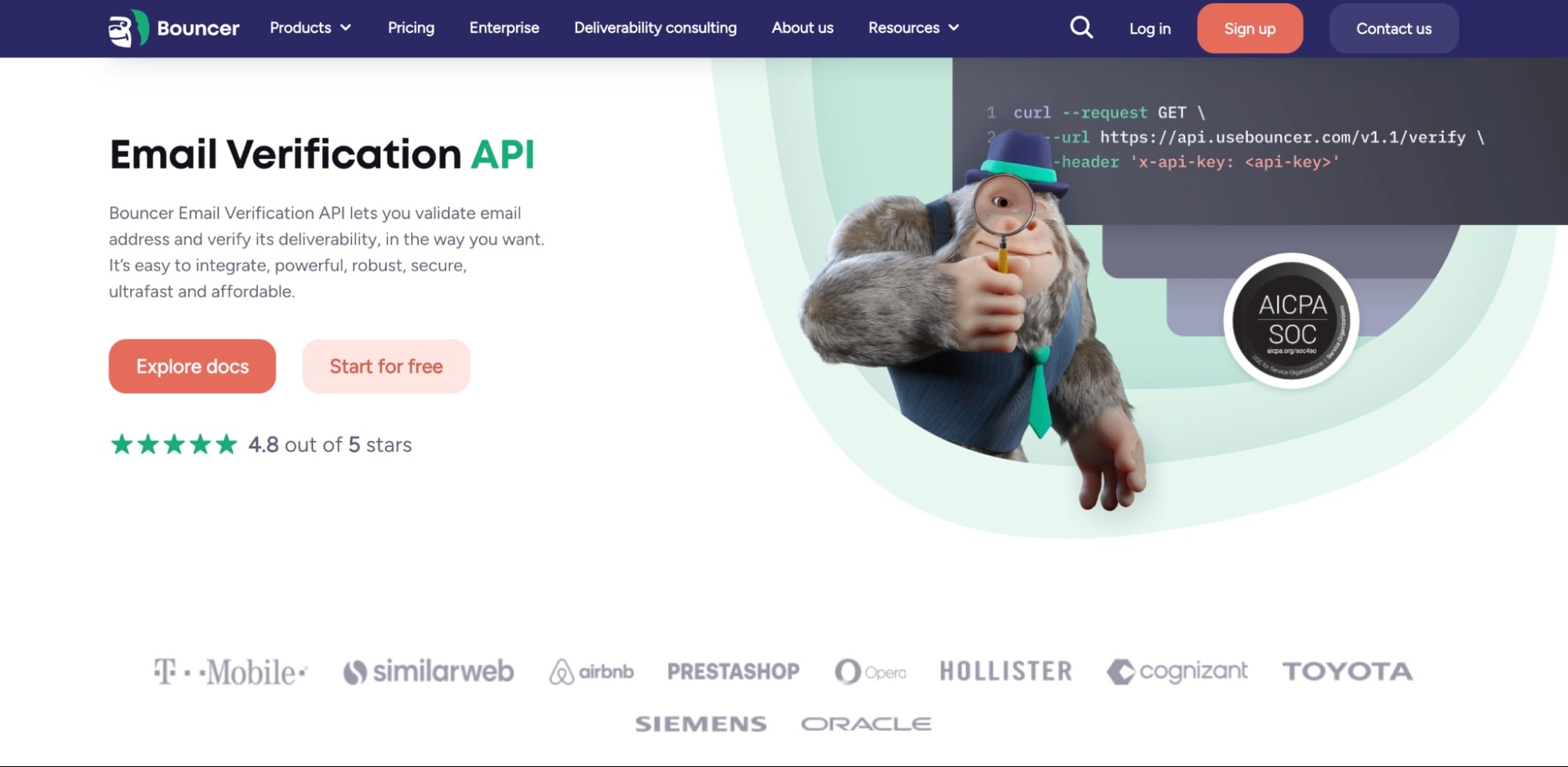
Bouncer positions itself as a security-conscious email verification and deliverability platform, with an email verification API and deliverability kit for inbox placement and blocklist testing.
📌 Best for: Teams that care deeply about security, governance, and flexible credit usage.
- Credits never expire, and you’re not charged for duplicates or unknowns.
- Deliverability-oriented add-ons (Deliverability Kit, Bouncer Shield, Toxicity Check) let you go beyond just “valid vs invalid.”
- Real-time verification for forms and deep ESP integrations.
- Some teams find the pricing and feature matrix a bit complex at first glance.
- Fewer native SDKs than some competitors; you’ll usually call the REST email verifier API directly.
If credits that never expire and strong security controls matter to your legal and ops teams, Bouncer deserves a serious look.
6. MailerCheck – marketer-friendly with strong real-time API
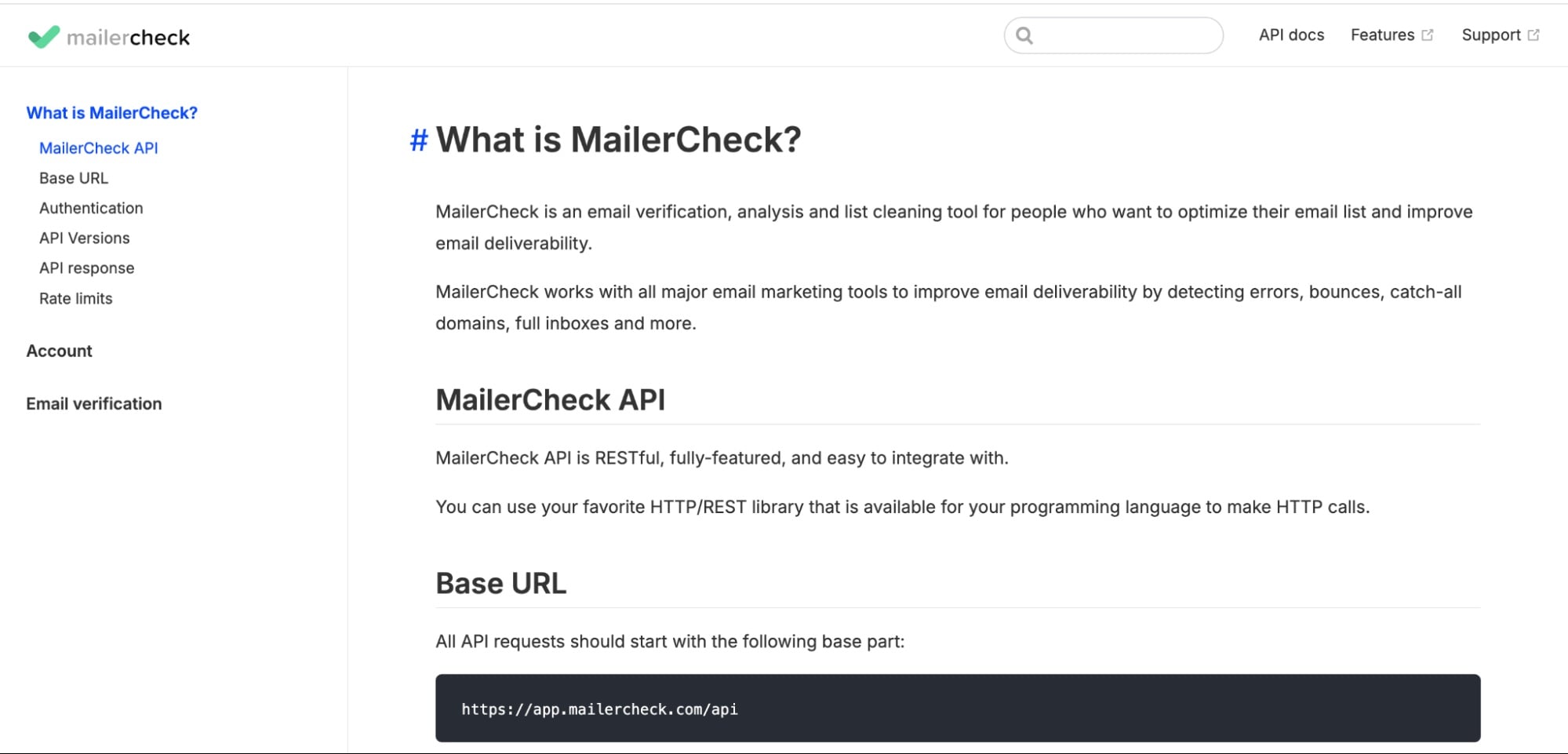
MailerCheck targets marketers and product teams who want list cleaning plus deliverability insights. Its email validation API can be wired into your forms to verify new addresses in real time and filter out typos, errors, catch-all domains, and more.
📌 Best for: Marketers who want reporting and UI clarity, without sacrificing API power.
- Real-time validate email address API that screens out bad addresses as they’re entered.
- Additional deliverability tools for content and inbox insights.
- Good integration with common ESPs and marketing tools.
- Less focused on extremely high API throughput than some developer-first rivals.
- Pricing is competitive but not the cheapest in the category at high volumes.
MailerCheck is a comfortable fit if your primary lens is “campaign performance and list health,” with API as the extension of that.
7. NeverBounce – long-time player, still competitive
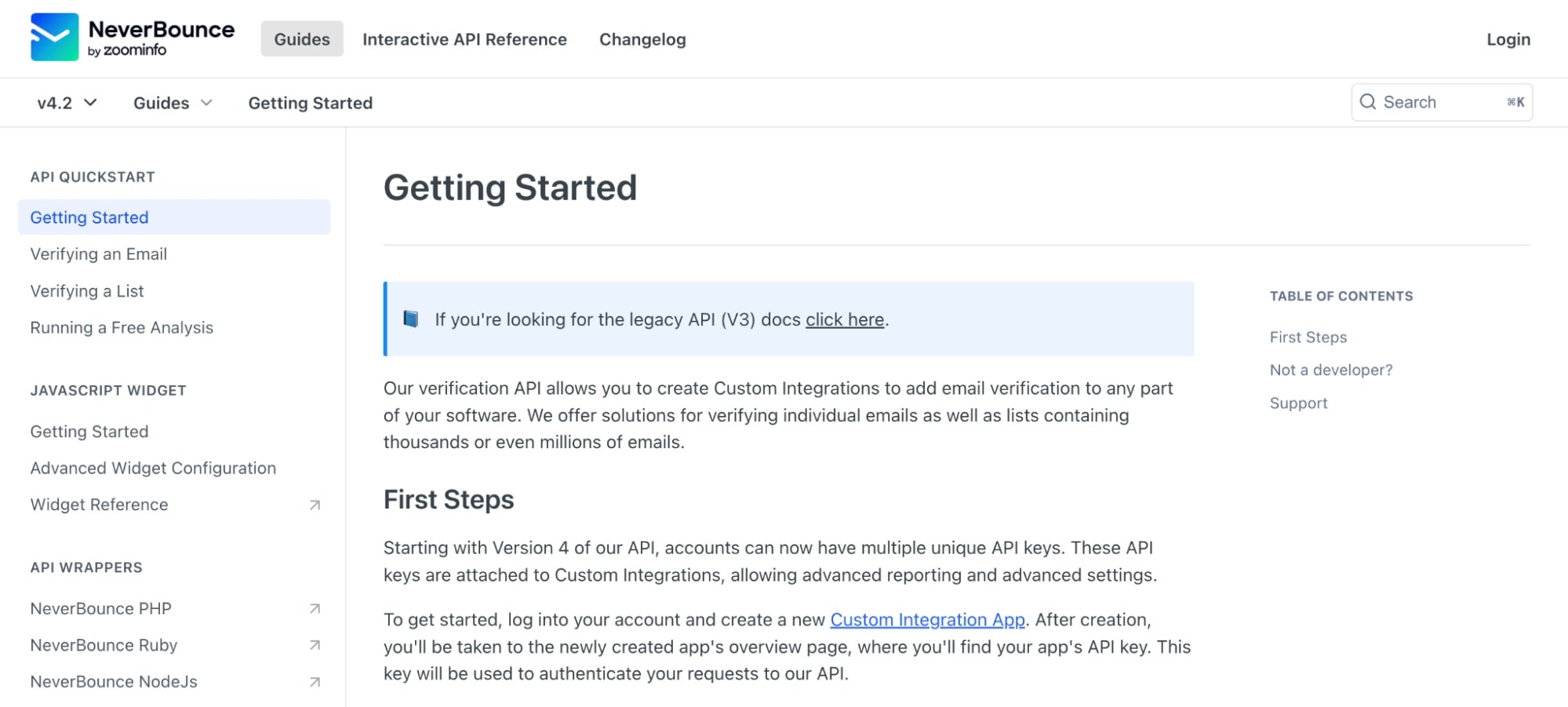
NeverBounce has been around for years and remains a common benchmark for list cleaning. It runs on a credit-based system where one credit equals one email verification and those credits work across bulk, API, and real-time checks.
📌 Best for: Teams that want a proven vendor with clear pricing and strong bulk capabilities.
- Fast bulk processing (e.g., 10k emails in a few minutes) with a long track record.
- Credits never expire, which smooths out sporadic usage.
- Simple “one credit = one verification” model that works across channels.
- Limited free trial (very small number of free credits).
- The feature set feels less modern than platforms that also package continuous monitoring and advanced deliverability tooling.
If you mainly need bulk cleaning with occasional real-time checks, NeverBounce still does the job. As a validated email API, it’s solid rather than standout.
8. Clearout – aggressive pricing and lead-focused features
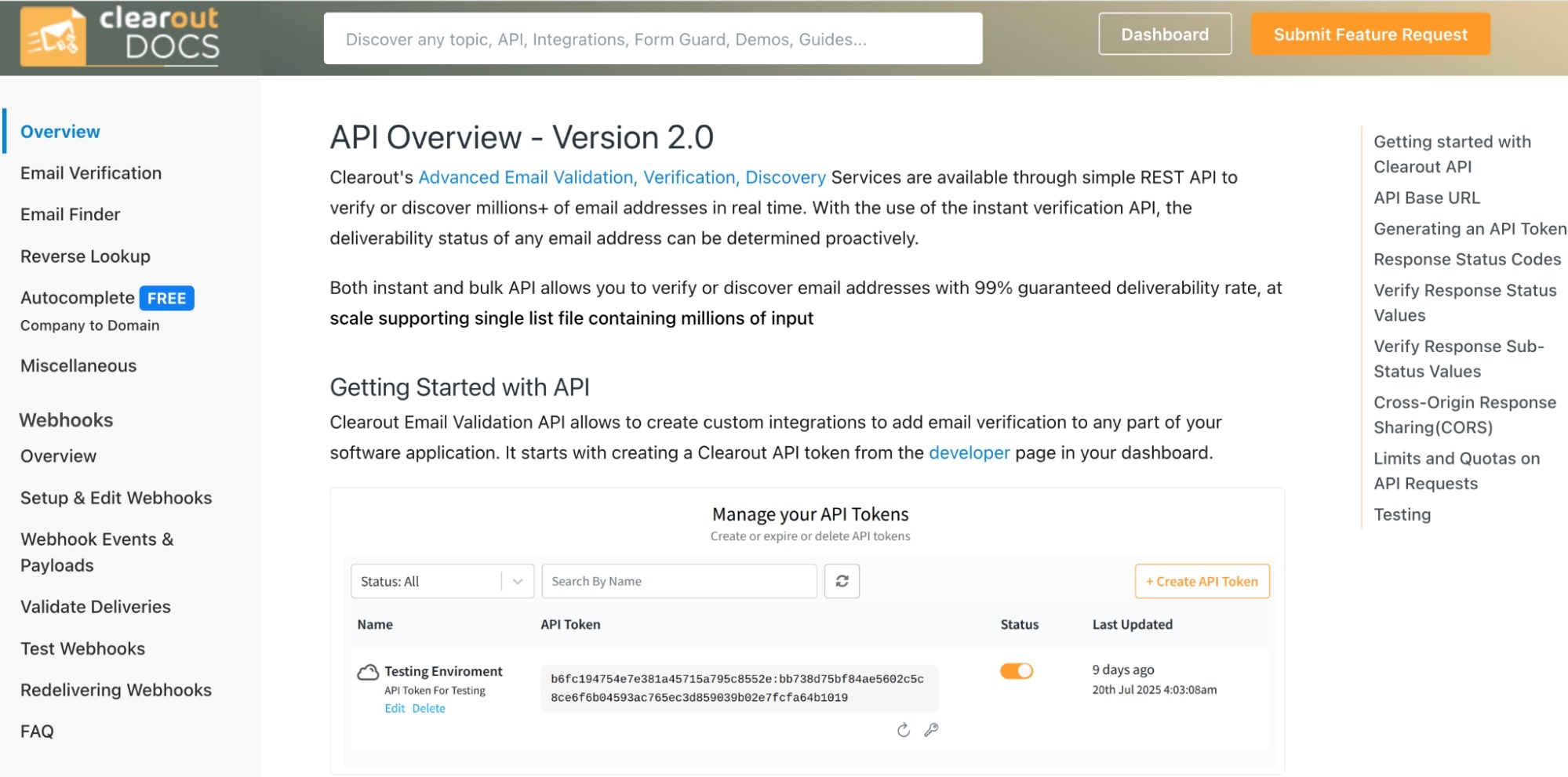
Clearout API offers >98% claimed accuracy, quick single checks, and bulk list verification with detailed statistics (spam traps, hard/soft bounces, disposable and catch-all addresses).
📌 Best for: Teams that want competitive pricing, sales prospecting options, and a decent email verification API.
- Strong accuracy claims and deep status breakdowns for risky addresses.
- Lead-finding tooling for B2B prospecting alongside verification.
- Good value at mid-range volumes.
- API & developer ergonomics are fine but not the cleanest in the market.
- Documentation and SDKS are less polished than what you get from the most developer-centric vendors.
Clearout is a reasonable choice if your primary world is outbound sales and prospecting, and verification is one part of that.
Comparison Table: Leading Email Verification APIs
| Tool |
|---|
| VerifiedEmail |
| ZeroBounce |
| Kickbox |
| Emailable |
| Bouncer |
| MailerCheck |
| NeverBounce |
| Clearout |
| Best for | Key strengths | Main caveats | Real-time API | Free tier / trial (2025) | Indicative starting pricing |
|---|---|---|---|---|---|
| Deliverability-focused teams, SaaS & ESP integrations | Real-time API, 99% precision bulk cleaning, continuous maintenance, strong pricing at scale | Newer brand vs legacy players; fewer third-party benchmarks so far | Yes | 200 free verifications on signup | From $7 for 1,000 verifications |
| Enterprises, compliance-heavy orgs | Rich feature set (spam traps, DEA, catch-all), strong integrations | Higher per-email cost; heavier API & docs | Yes | 100 free credits on some plans | From 2k emails at $18–$20 |
| Developer teams, SaaS products at scale | Mature kickbox email verification API, clear statuses, 100 free checks | Not the cheapest at very high volume; slightly behind top accuracy leaders in some tests | Yes | 100 free verifications | From $5 for 500 verifications |
| Mid-market teams needing speed + flexible pricing | 99% delivery guarantee, 99.99% uptime, unknowns/duplicates often free | Can slow on very large lists; can get pricey at scale | Yes | 250 free credits on signup | From $38 for 5k credits |
| Security-sensitive orgs, agencies with many clients | Credits never expire, not charged for unknowns/duplicates, deliverability kit | Pricing & feature mix can look complex initially | Yes | 100 free credits, volume discounts | From $8 for 1k credits; $400 for 100k |
| Marketers wanting UI + API + deliverability tools | Real-time validate email API, deliverability insights, strong ESP integrations | Less optimized for ultra-high API throughput | Yes | 200 free credits in many plans | From around $10–$45 for 1k–5k credits |
| Established senders with large, static lists | Fast bulk processing, credits never expire, API covers bulk & real-time | Very small free trial; tooling feels older than newer platforms | Yes | 10 free credits | From $8 for 1k credits |
| Sales & marketing teams with prospecting needs | 98%+ accuracy claims, detailed status reports, finder + verifier combo | Docs and dev UX behind the more API-centric tools | Yes | 100 free credits | From $21–$35 for 3k–5k credits |
📌 Snapshot only – pricing and free tiers change frequently, so always confirm on the vendor’s site.
How to Choose the Right API to Verify Email Address
Let’s translate all of this into actual selection logic.
1. If you’re wiring a real-time signup or checkout flow
You’re looking for:
- Low latency and high uptime.
- Friendly failure modes if the web API email verifies call times out.
- Clear statuses you can safely act on in milliseconds.
In that world, you want a verify email address API that:
- Flags obvious garbage (syntax errors, known disposable providers).
- Handles gray areas with a score or “risky” label instead of guessing.
- Lets you configure what happens on unknown (e.g., let the user in, but mark for re-check).
VerifiedEmail and Kickbox score well here; both have real-time API endpoints and are designed explicitly for point-of-capture validation.
2. If you’re cleaning large lists a few times a year
You care more about:
- Bulk job throughput and accuracy.
- Pricing at 100k–1M+ emails.
- Detailed reporting so you can decide what to do with “risky.”
In this case, pay close attention to:
- Whether the email verify API charges you for unknowns and duplicates.
- How granular the categories are (e.g., disposable vs spam trap vs role-based).
- Whether you can schedule or automate via API for future runs.
Bouncer’s non-expiring credits and no-charge unknowns are helpful here, and NeverBounce remains a strong fit for large, infrequent bulk jobs thanks to its long-standing batch processing reliability.
3. If you’re an agency or ESP
Your problems are different:
- Multiple client accounts with different risk tolerances.
- Governance and access control.
- Reporting that helps you justify decisions.
Look for an email verifier API that:
- Supports multi-tenant usage or organizations.
- Has clear logs and reason codes.
- Plays nicely with your existing deliverability stack.
ZeroBounce and Emailable tend to suit agency workflows well — both offer broad integrations, structured reporting, and easy client-by-client segmentation.
4. If you’re budget-sensitive but care about quality
Any email verification API will cost less than a bad sender reputation — but that doesn’t mean pricing doesn’t matter.
Look especially at:
- Cost per 100k / 1M emails across vendors.
- Whether credits expire.
- How aggressively each email validator API labels addresses as “unknown.”
VerifiedEmail offers some of the most aggressive volume pricing, while Clearout is popular with teams that want predictable long-term cost curves and minimal restrictions on credit usage.
Conclusion
There is no one-size-fits-all best email verification API in the abstract. There’s only the best fit for:
- Your volume and growth curve.
- Your tech stack and team skills.
- Your tolerance for risk vs cost.
ZeroBounce might make sense if you want a heavyweight platform with enrichment and deep integrations. Kickbox is a comfortable middle ground for developer teams who want a proven email verifier API. Emailable, Bouncer, MailerCheck, NeverBounce, and Clearout all have credible positions for different niches.
If you want a modern, API-first platform that treats verification as part of an overall deliverability improvement strategy — with real-time checks, bulk cleaning, and continuous maintenance — VerifiedEmail deserves a place at the top of your shortlist.
The rest is straightforward, though not always easy: wire the API in carefully, follow best practices, and let clean data quietly power the campaigns your audience actually wants to receive.
💡 Find our what are the best affordable bulk email verification tools in our article.
Verify 200 emails for free. For lists over one-million emails, we will beat the price of any competitor, guaranteed.